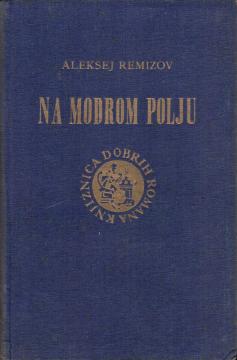
Na modrom polju
Antique
Rare book

Na modrom polju

Aleksej Remizov

The story of a girl named Olya Ilymeneva in a pre-revolutionary Russian village and province. Through a folkloric, ornamental style, Remizov describes her life, family, pilgrims, everyday life, and spiritual quest on the "blue field" of the Russian land.

“On the Blue Field” (1922) is a short novel (story) by Alexei Remizov, one of the most important Russian modernists and émigrés. The novel is autobiographical in tone – it is based on the life of Remizov’s wife Serafima Pavlovna Remizova-Dovgello.

The main character is Olya Ilmenyeva, a girl from a wealthy provincial family in the village of Vatagin, through which the pilgrimage routes to Kiev and Chernigov pass. The story follows her childhood, youth, family relationships, encounters with pilgrims, peasants and everyday life in Russian provincial life in the late 19th and early 20th centuries.

Remizov writes in a characteristic ornamental, folkloric-poetic style – rich in archaisms, repetitions, rhythm and close to Russian oral storytelling and old chronicles. There is no classic dramatic plot or major external conflicts; the action flows calmly, almost chronicling-like, with an emphasis on atmosphere, customs, beliefs and the inner spiritual world of the characters. “Blue Field” symbolizes the Russian land, infinity, sky and the spiritual dimension of life.

The book exudes warmth, melancholy and love for old Russia, its ordinary people, faith and folklore. Remizov masterfully depicts a world full of miracles, suffering and everyday beauty – pilgrims, icons, family stories, nature. The style is demanding, but hypnotic: a mixture of realism, symbolism and Russian ornamentality (tale). The work belongs to his “quieter”, more intimate works, in contrast to the grotesque and demonic stories from the same period.

Original title
В поле блакитном
Translation
Ljubomir Maraković
Editor
Josip Andrić
Dimensions
19 x 13 cm
Pages
172
Publisher
Hrvatsko književno društvo Sv. Jeronima, Zagreb, 1928.
 
Latin alphabet. Hardcover.
Language: Croatian.

One copy is available

Condition:Used, excellent condition
 

Are you interested in another book? You can search the offer using our search engine or browse books by category.

You may also be interested in these titles

Sabrana djela A. P. Čehova #3: Drama u lovu i druge novele

Sabrana djela A. P. Čehova #3: Drama u lovu i druge novele

Anton Pavlovič Čehov

The third volume of Collected Works contains Chekhov's most extensive novella, "A Drama in Hunting," as well as a number of longer stories from the period 1885-1886. There are humoresques such as Silo in a Bag, Eh, That Audience, and A Lot of Paper, as we

Zora, 1959.
Croatian. Latin alphabet. Hardcover with dust jacket.
8.74
Sabrana djela A. P. Čehova #4: Dan izvan grada

Sabrana djela A. P. Čehova #4: Dan izvan grada

Anton Pavlovič Čehov

The fourth volume of Chekhov's works contains novellas and humoresques, which were mostly written in 1886. Still writing for a fee in daily newspapers, Chekhov often had to subordinate his art to comprehensibility and cheap humor due to the taste of the r

Zora, 1959.
Croatian. Latin alphabet. Hardcover with dust jacket.
9.56
12 stolica

12 stolica

Ilja Iljf, Jevgenij Petrov

A satirical search for hidden treasure in post-revolutionary Russia. Former nobleman Ippolit Matveyevich Vorobyaninov and con artist Ostap Bender chase after valuables, exposing the greed and absurdities of Soviet society.

Šareni dućan, 2013.
Croatian. Latin alphabet. Hardcover.
16.54
Djela #15: Pripovetke / Drame

Djela #15: Pripovetke / Drame

Maksim Gorki

The book contains the following stories and plays: Three Days, Theft, Criminals, Thefts, Fake Money and The Old Man.

Kultura, 1949.
Serbian. Latin alphabet. Hardcover.
4.56
Mati

Mati

Maksim Gorki

Maxim Gorky's novel "Mother" was published in 1906 and is one of the key works of Russian social realism. The work depicts the awakening of the working class in Russia through characters and events that emphasize social injustices and the need for revolut

Svjetlost, 1975.
Croatian. Latin alphabet. Hardcover.
4.26
Poziv na pogubljenje

Poziv na pogubljenje

Vladimir Nabokov

There is no doubt that it is most attractive to read The Call to Execution as it appears to be written, as an anti-utopian or anti-totalitarian novel...

Nolit, 1988.
Serbian. Latin alphabet. Hardcover with dust jacket.
12.32