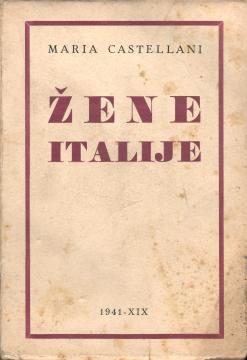
Žene Italije
An overview of the history and position of Italian women from antiquity to Mussolini's fascist Italy, with an emphasis on their contribution to society and culture. A popular educational publication from the period of the Independent State of Croatia, wit
Maria Castellani was an Italian publicist, economist and activist in women's organizations during the Fascist period. The book presents an overview of the role of women in Italian history – from ancient Rome, through the Renaissance and the Risorgimento, to Mussolini's Italy. The author highlights the contribution of women to culture, art, science and social life, but also their traditional place in the family and nation.
In keeping with the spirit of the times (Fascist Italy), the book combines historical overview with propaganda: it praises the "new Italian woman" – a mother, wife and patriot who actively participates in the construction of the Fascist state, but remains faithful to traditional values. A special chapter is dedicated to contemporary women, their education, work and organizations (e.g. Fascist women's sections).
The style is popular, accessible and propaganda-tinged – typical of non-fiction of the 1930s and early 1940s. The book contains photographs and illustrations depicting famous Italian women throughout history and contemporary women in various roles.
In the context of Croatia in 1941 (the beginning of the NDH and the alliance with Italy and the Axis), this edition also had a political dimension – strengthening cultural and ideological ties with fascist Italy. It was part of a wider publishing activity that presented “friendly” countries and their values to the Croatian reader.
Today, this edition is relatively rare and interesting as a historical document. It serves as an example of how the image of women was constructed in fascist Italy – between emancipation and traditionalism. The book will appeal to fans of old journalism, those who study the history of the women's movement, fascist propaganda or Italian-Croatian cultural relations in World War II.
One copy is available
- Slight damage to the cover
- Traces of patina