O nacionalnoj istoriji kao vaspitnom predmetu
Rare book

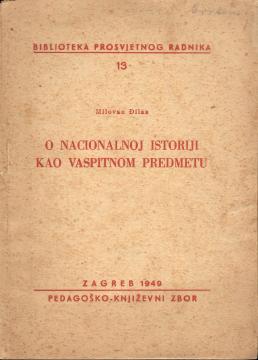
O nacionalnoj istoriji kao vaspitnom predmetu

Milovan Đilas

A programmatic text in which Đilas, as a senior party ideologist, sets out Marxist-Leninist guidelines for the teaching and writing of national (Yugoslav) history as a means of education and ideological struggle.

The work was first published as an article in the party magazine Komunist (No. 1, 1949, pp. 57–82), and soon after as an independent brochure. It was created in the context of Informbiro and V. Congress of the Communist Party of Yugoslavia, when the Yugoslav leadership emphasized its own path to socialism and the need for a new approach to history that would serve to educate new generations in the spirit of Marxism-Leninism, but adapted to Yugoslav circumstances.

Đilas writes the text as an official party instruction to every writer and lecturer of national history. The key theses are:

  • History must be written and taught strictly on the basis of dialectical and historical materialism — the ideology of the working class and the Communist Party of Yugoslavia.
  • National history must be simultaneously the history of all the peoples of Yugoslavia, without neglecting or exaggerating any one people (against "national nihilism", but also against bourgeois chauvinism).
  • Emphasis on progressive forces, revolutionary movements, great personalities and masses as bearers of history, with a critical exposure of reactionary forces and class contradictions.
  • Criticism of previous textbooks (e.g. harsh criticism of Ante Babić for schematism and “national nihilism”, milder towards Jagoš Jovanović).

The text is typical of the early post-war period: it combines the demand for scientificity (concrete analysis, archival work) with a clear ideological function — history as a weapon in the construction of socialism and Yugoslav brotherhood and unity. Đilas emphasizes that history “lives in the consciousness of people” and is therefore extremely important for the education of young people.

Dimensions
20 x 14 cm
Pages
31
Publisher
Pedagoško-književni zbor, Zagreb, 1949.
 
Latin alphabet. Paperback.
Language: Serbian.

One copy is available

Condition:Used, excellent condition
Damages or inconvenience notice:
  • Traces of patina
 

Are you interested in another book? You can search the offer using our search engine or browse books by category.

You may also be interested in these titles

Komunisti Jugoslavije 1919-1979.

Komunisti Jugoslavije 1919-1979.

Pero Morača, Stanislav Stojanović

The book provides an overview of the history of the Communist Party of Yugoslavia (KPJ) from its founding to the late 1970s, emphasizing its role in the revolution, self-government, and construction of Yugoslavia, with an ideologically colored perspective

Eksportpres, 1979.
Serbian. Latin alphabet. Hardcover with dust jacket.
11.98
Zaraćeno poraće: Konfliktni i konkurentski narativi o stradanju i iseljavanju Talijana Istre

Zaraćeno poraće: Konfliktni i konkurentski narativi o stradanju i iseljavanju Talijana Istre

Franko Dota

The book analyzes how conflicting historical narratives about the suffering and mass emigration of Italians from Istria and Rijeka developed in Croatia and Italy after World War II (1943–1956), debunking myths and encouraging an empathetic approach to the

Srednja Europa, 2010.
Croatian. Latin alphabet. Paperback.
11.32
Historija porodice Alibegović: transformacija iz begovske zemljoposjedničke u modernu građansku porodicu

Historija porodice Alibegović: transformacija iz begovske zemljoposjedničke u modernu građansku porodicu

Husnija Kamberović

The book depicts the development of a Bosnian bey family that, throughout the 19th and 20th centuries, transformed from a landowning family into a modern bourgeois family, reflecting broader social changes in Bosnia and Herzegovina.

Udruženje za modernu historiju (UMHIS), 2021.
Croatian. Latin alphabet. Paperback.
18.52
Teror narodu: Povijest OZNE, Titove političke policije

Teror narodu: Povijest OZNE, Titove političke policije

William Klinger

In the book, historian William Klinger investigates the origin and operation of OZNA - the brutal repressive apparatus of communist Yugoslavia, which monitored, imprisoned and liquidated political opponents.

Večernji list, 2014.
Croatian. Latin alphabet. Paperback.
7.34
Doživljaji i putovanja do slobode

Doživljaji i putovanja do slobode

Vladimir Novak

The autobiographical work of Croatian communist activist Vladimir Novak, a survivor of the Ustasha camps, follows his memories of resistance to fascism during World War II.

August Cesarec, 1979.
Croatian. Latin alphabet. Hardcover with dust jacket.
8.26
Nacionalni testament kralja Aleksandra I

Nacionalni testament kralja Aleksandra I

Branislav M. Stepanović

The author presents the political and ideological legacy of King Aleksandar I Karađorđević the Unifier. The book, published immediately after the king's death, is an attempt to preserve and transmit his political ideals to future generations.

Jugoslovenska biblioteka "Bratstvo", 1936.
Serbian. Cyrillic alphabet. Hardcover.
28.36