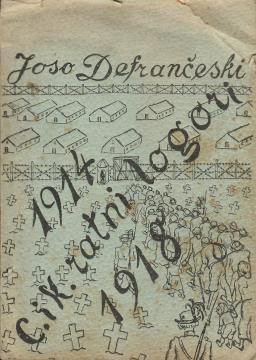
C. i Kr. ratni logori 1914.–1918.
Antique
Rare book

C. i Kr. ratni logori 1914.–1918.

Joso Defrančeski

The first comprehensive account of the suffering of Istrian civilians (mostly women, children and the elderly) in Austro-Hungarian refugee camps during World War I, based on the personal memories of the author from Ližnjan.

Josip (Jose) Defrančeski's book *C. and Kr. war camps 1914–1918. is one of the most important testimonies about the humanitarian catastrophe that befell the population of Southern Istria after Italy entered the war in 1915. The Austro-Hungarian authorities evacuated (or expelled) tens of thousands of civilians — mostly Croats from the Pula and Ližnjan areas — to camps and settlements in Hungary, Moravia, the Czech Republic and Austria. The worst was in the large refugee camp Gmünd in Lower Austria, where thousands died of hunger, typhus, dysentery and other diseases due to catastrophic conditions.

The author Joso Defrančeski (Ližnjan, 1906 – Argentina, mid-1970s) wrote the book based on his own traumatic childhood experience. As a nine-year-old, he was expelled from Ližnjan with his mother, brothers, grandmother and grandfather. In the Gmünd camp, he lost his younger brother Ivica and his grandfather. The book is therefore at the same time a personal memoir and a broader historical documentation of the fate of the Istrian "evacuees". Defrančeski emphasizes that he did not exaggerate anything, but even toned down a lot.

The book represents the first comprehensive presentation of this topic in Croatian (Yugoslav) literature. It later saw an expanded edition (Ližnjan, 2015). The style is direct, emotional and documentary, with many specific names, places and destinies. The book is not only an accusation against the Austro-Hungarian authorities for negligence and inhumane treatment, but also a valuable source for studying the First World War "in the background", the Italianization of Istria and the fate of the Istrian Croats.

Today it is considered a bibliographical rarity. Copies of the first edition from 1937 appear very rarely on the market and are sought after among collectors of Istrian themes, literature about the First World War, and regional history.

Dimensions
20 x 14 cm
Pages
200
Publisher
Štamparija Antun Rott, Osijek, 1937.
 
Latin alphabet. Paperback.
Language: Croatian.

One copy is available

Condition:Used, very good condition
Damages or inconvenience notice:
  • Traces of patina
  • Slight damage to the cover
 

Are you interested in another book? You can search the offer using our search engine or browse books by category.

You may also be interested in these titles

Hrvatske pravice

Hrvatske pravice

Petar Požar

"Croatian Rights" presents a selection of key historical documents that shape the Croatian legal tradition – from medieval charters to modern acts – emphasizing the continuity of Croatian autonomy within the broader European framework.

Vlastita naklada, 1990.
Croatian. Latin alphabet. Hardcover.
5.31
Rakovica: o 60. godišnjici smrti Eugena Kvaternika

Rakovica: o 60. godišnjici smrti Eugena Kvaternika

Milutin Cihlar Nehajev

Nehajev's "Rakovica", in the edition edited by Blaž Jurišić, presents the Rakovica Rebellion, its causes and ideas. Nehajev did not finish the book due to his sudden death; it was completed and edited by Blaž Jurišić.

Matica hrvatska, 1932.
Croatian. Latin alphabet. Hardcover.
8.265.78
Povijest Bosne u doba osmanlijske vlade I-II

Povijest Bosne u doba osmanlijske vlade I-II

Milan Prelog

An overview of Ottoman rule in Bosnia through political, social and economic changes and the creation of a new order. Reprint from 1913.

Fortuna d.o.o., 2023.
Croatian. Latin alphabet. Hardcover.
20.00
Politika sporazuma: dnevničke beleške 1939-1941, londonske beleške 1944-1945

Politika sporazuma: dnevničke beleške 1939-1941, londonske beleške 1944-1945

Mihailo Konstantinović

The generation to which Konstantinović belonged managed to reach an agreement and, had it not been for the Second World War, was on the threshold of establishing liberal democracy in Yugoslavia, whose supporter Konstantinović was.

Agencija Mir, 1998.
Serbian. Latin alphabet. Hardcover.
39.99
Starohrvatska seoska zajednica

Starohrvatska seoska zajednica

Miho Barada

In his work Starohrvatska seoska zajednica (The Old Croatian Village Community) (1957), Miho Barada analyzes the social and agrarian organization of early medieval Croatian villages, their institutions, ownership relations, and common land based on origin

Jugoslavenska akademija znanosti i umjetnosti (JAZU), 1957.
Croatian. Latin alphabet. Paperback.
10.00
Izvori za hrvatsku povijest do 1526. godine

Izvori za hrvatsku povijest do 1526. godine

Nada Klaić

The work presents key narrative and diplomatic sources for Croatian history up to 1526, with a critical analysis of their reliability, context, and interconnections, and emphasizes the development of Croatian political structures throughout the Middle Age

Fortuna d.o.o., 2019.
Croatian. Latin alphabet. Hardcover.
22.56