Što je masonerija?
Rare book
Antique

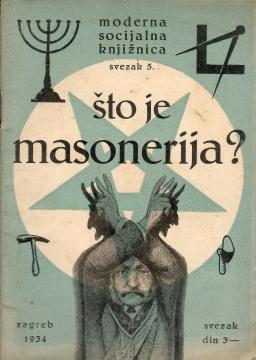
Što je masonerija?

What is Freemasonry? (1934) is a popular pamphlet that presents the origins, organization, and activities of Freemasonry and analyzes its social, political, and cultural influence from the perspective of Catholic social doctrine.

What is Freemasonry? is a booklet that belongs to a series of popular brochures that addressed current social, political and ideological issues from the perspective of Catholic social doctrine. At the time of its publication, the topic of Freemasonry was the subject of numerous public debates, so the purpose of the publication was to bring the emergence, organization and activities of Freemasonry closer to the wider public.

The publication provides an overview of the historical development of Freemasonry from its beginnings in Europe, explains the structure of Masonic lodges, symbolism, rituals and principles on which the activities of Masonic organizations are based. Special attention is paid to the influence of Freemasonry on political, social and cultural processes in Europe and the former Yugoslavia. The author seeks to present Freemasonry as a movement that operates outside the framework of traditional religious institutions and considers its relationship to religion, state and society.

Like other publications from the MOSK library, the booklet has a distinct educational and polemical character. It is written in a simple and accessible style in order to be understandable to a wide range of readers. The text reflects the Catholic perspective of the 1930s, which is why it views Freemasonry critically and warns of ideological differences between Masonic principles and church doctrine.

Today, this brochure is interesting primarily as a historical document that testifies to the social and ideological debates of the interwar period in Croatia. In addition to providing insight into the understanding of Freemasonry at the time, it shows how Catholic intellectual and cultural organizations sought to inform the public about issues they considered important for the social and moral life of the community.

Dimensions
17 x 12 cm
Pages
32
Publisher
Moderna socijalna knjižnica (MOSK), Zagreb, 1934.
 
Latin alphabet. Paperback.
Language: Croatian.

One copy is available

Condition:Unused
 

Are you interested in another book? You can search the offer using our search engine or browse books by category.

You may also be interested in these titles

Miroslav Cerar

Miroslav Cerar

Boris Kolomičuk

Miroslav Cerar's biography follows the rise of the top gymnast, his work, discipline and sporting triumphs, and shows how talent, perseverance and modesty shaped one of the greatest athletes of his time.

Stvarnost, 1964.
Croatian. Latin alphabet. Paperback.
7.32
Dječije kolo – almanah za mladež raznih pisaca

Dječije kolo – almanah za mladež raznih pisaca

The Children's Circle is a rare children's almanac from 1921, edited by Osijek writer and educator Rudolfo Franjin Magjer. It contains selected texts (songs, stories, educational essays) by several writers intended for young people.

Hrvatski štamparski zavod d.d., 1921.
Croatian. Latin alphabet. Hardcover.
5.46
Mahatma Gandi

Mahatma Gandi

Dušan Aleksić

A short popular biography/sketch about the life and ideas of Mahatma Gandhi, with an emphasis on non-violence and the struggle for Indian independence.

Izdavačka knjižarnica Skerlić, 1932.
Serbian. Latin alphabet. Paperback.
3.46
Heinz Brandt, der Fremdenlegionär Nr. 61-70 (1914.)

Heinz Brandt, der Fremdenlegionär Nr. 61-70 (1914.)

A rare opportunity for collectors! A professionally bound set of 10 original newsstand novels (Heftromane) from the legendary German series Heinz Brandt, der Fremdenlegionär, issues 61 to 70. Extremely rare on the market.

Mignon-Roman-Verlag, 1914.
German. Gothic. Hardcover.
The book consists of 11 volumes
115.00
O nacionalnoj istoriji kao vaspitnom predmetu

O nacionalnoj istoriji kao vaspitnom predmetu

Milovan Đilas

A programmatic text in which Đilas, as a senior party ideologist, sets out Marxist-Leninist guidelines for the teaching and writing of national (Yugoslav) history as a means of education and ideological struggle.

Pedagoško-književni zbor, 1949.
Serbian. Latin alphabet. Paperback.
14.36