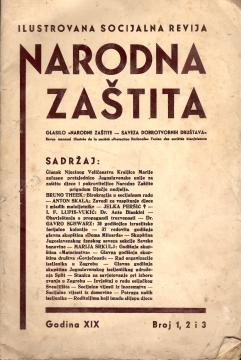
Narodna zaštita - glasilo Saveza dobrotvornih društava, br. 1, 2 i 3, god. XIX
"Narodna zaštika" was the newsletter of the Association of Charitable Societies "Narodna zaštika". Illustrated social revue dedicated to humanitarian work, protection of children, orphans and the socially vulnerable in the Kingdom of Yugoslavia.
National Protection – the journal of the National Protection – the Union of Charitable Societies (Revue mensuel illustrée de la société „Protection nationale“ l’union des sociétés bienfaisances) was an important Croatian social and humanitarian periodical published in Zagreb from 1919 to 1934. It continued the tradition of an earlier newspaper from the First World War (from 1917), and under this name it became the official journal of the Union of Charitable Societies “National Protection“.
The Union acted as an umbrella organization of numerous charitable societies (over 150 branches), mostly women's, focused on practical social work: caring for war orphans and hungry children, colonization from hungry areas to more fertile areas, legal protection of emigrants, assistance to the poor, suppression of begging, protection of girls from the white slave trade, and care for delinquent youth. The organization was one of the most important parastatal social institutions in Croatia between the two world wars.
Issues 1, 2 and 3 from 1934 represent the last issues in the last year of the magazine's publication. As an illustrated monthly (or quarterly) social review, it published articles, reports, pedagogical and medical contributions, statistics on social problems, reviews of the Association's actions and humanitarian appeals. The texts were published in Croatian (Latin and Cyrillic). The editors and contributors were prominent intellectuals and social workers such as dr. Josip Šilović (long-time president of the Association, called the father of Croatian social policy and child protection), Đuro Basariček, Milica Bogdanović and others.
The magazine reflected the broader European trend in the development of social work and social medicine (influenced by Andrija Štampar and others), combining a charitable approach with more modern professional elements. During the time of the Kingdom of Yugoslavia, it operated in complex political and economic conditions — economic crisis, poverty and social tensions.
Today, copies from 1934 are rare and represent an important source for studying the history of social work, humanitarian work and civil society in Croatia before World War II. Narodna zaštita testifies to a strong tradition of voluntary and organized social engagement in the turbulent interwar period.
One copy is available
- Slight damage to the pages