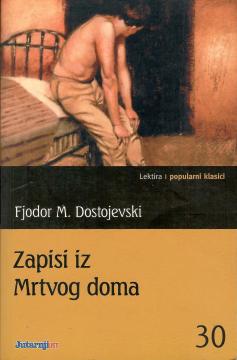
Zapisi iz mrtvog doma / Zimske bilješke o ljetnim dojmovima / Zapisi iz podzemlja
Rare book

Zapisi iz mrtvog doma / Zimske bilješke o ljetnim dojmovima / Zapisi iz podzemlja

Fjodor M. Dostojevski

Notes from a Dead Home (1860-1862) - a novel based on the author's imprisonment in Siberia. Winter Notes on Summer Impressions (1863) - an essay from a trip to Europe in 1862. Notes from the Underworld (1864) is a philosophical novel about a man torn by i

  • Notes from the Dead House: The narrator, Alexander Petrovich Goryanchikov, is convicted of murder and describes life in the camp. Through a series of vignettes, Dostoevsky depicts the harshness of prison life, but also the complexity of human nature – from cruelty to compassion. The inmates, of different classes and characters, reveal universal themes of suffering, hope and resistance. The novel explores moral issues, freedom and strength of spirit, emphasizing how a person can preserve dignity in the worst conditions.

  • Winter Notes on Summer Impressions: A travelogue-philosophical essay in which Dostoevsky, through a satirical tone, criticizes Western society, especially French utopian socialism and materialism. It emphasizes Russian spiritual identity in contrast to Western rationalism, reflecting on freedom, religion and social ideals. The work is introspective, with an emphasis on the conflict between individualism and collectivism, and Dostoevsky's skepticism towards Western models of progress.

  • Notes from the Underground: a philosophical novel in which an "underground man", an unnamed narrator living in isolation, conducts an internal monologue. In the first part, he criticizes rationalism, determinism, and utilitarianism, defending free will even if it leads to self-destruction. The second part, "On Wet Snow", depicts his past encounters, including humiliating interactions with friends and a tragic relationship with the prostitute Liza, whom he manipulates to assert his power. The work explores existential anxiety, alienation, and the paradoxes of human consciousness.

All three works reflect Dostoevsky's obsession with moral, psychological, and spiritual questions, laying the foundations for existentialism and a deep analysis of the human soul.

Original title
Записки из Мёртвого дома
Translation
Vladimir Gerić
Graphics design
Halid Malla
Dimensions
19.5 x 13 cm
Pages
480
Publisher
Jutarnji list, Zagreb, 2005.
 
Latin alphabet. Paperback.
Language: Croatian.

One copy is available

Condition:Unused
 

Are you interested in another book? You can search the offer using our search engine or browse books by category.

You may also be interested in these titles

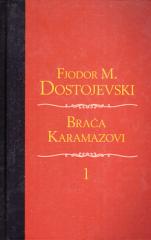
Braća Karamazovi

Braća Karamazovi

Fjodor M. Dostojevski

The Brothers Karamazov is the last novel of the Russian genius Fyodor Mikhailovich Dostoyevsky, which he completed less than three months before his death.

Globus, 2004.
Croatian. Latin alphabet. Hardcover.
16.24
Zločin i kazna

Zločin i kazna

Fjodor Mihajlovič Dostojevski

Crime and Punishment is a novel by Russian writer Fyodor Mikhailovich Dostoevsky, published in 1866 in the journal Russian Herald. It is considered one of the greatest works of Russian literature. The plot is set in Saint Petersburg in the mid-1860s.

Rad, 1988.
Serbian. Latin alphabet. Hardcover.
7.60
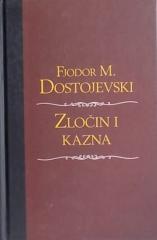
Zločin i kazna

Zločin i kazna

Fjodor M. Dostojevski

One of the most complex novels in world literature, which, through a criminal plot, thematizes issues of personal freedom, moral justification and the psychology of sin.

Jutarnji list, 2004.
Croatian. Latin alphabet. Hardcover.
14.42
Mrka kapa

Mrka kapa

Aristid Teofanović

Mrka kapa is a book of short prose written under the pseudonym Aristid Teofanović, used by Slobodan Blagojević. Blagojević is also known by the heteronym Anhel Antonić (poetry) and other works under his real name.

Feral Tribune, 2001.
Croatian. Latin alphabet. Paperback.
9.36
Sizifova sreća - razgovori, kronike

Sizifova sreća - razgovori, kronike

Ivan Lovrenović

Ivan Lovrenović's collection documents thirty years of change in Bosnia and Herzegovina through interviews, essays, and dialogues. The author, a witness to the era, examines old attitudes in the new reality, emphasizing the atrophy of rationality and soci

Synopsis, 2018.
Croatian. Latin alphabet. Paperback.
12.54
Antidnevnik prisjećanja: Pogled unatrag i unaprijed

Antidnevnik prisjećanja: Pogled unatrag i unaprijed

Vladimir Devidé

Vladimir Devidé, a Croatian mathematician, Japanologist and essayist, creates an intimate, fragmentary autobiography in Anti-Diary of Recollections through around twenty texts – essays, stories, humorous and satirical articles, travelogues, reflections an

Znanje, 1995.
Croatian. Latin alphabet. Paperback.
11.26