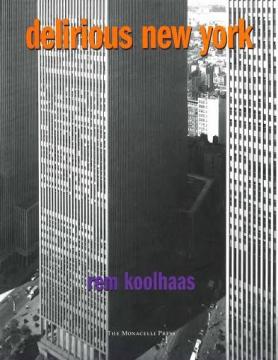
Delirious New York: A Retroactive Manifesto for Manhattan
Rem Koolhaas' Delirious New York (1978) is a retrospective manifesto of Manhattan. The book explores "Manhattanism" – an urban condition shaped by density, technology and fantasy that redefines architecture.
Delirious New York: A Retroactive Manifesto for Manhattan by Dutch architect Rem Koolhaas, published in 1978, is one of the most influential works of modern architectural and urban theory. Rather than a classical theoretical study, Koolhaas offers a dynamic and visionary interpretation of New York as an urban laboratory in which modern culture developed unplanned, but through an exceptionally strong internal logic.
The central concept of the book is "Manhattanism" (Manhattanism) – an unproclaimed urban doctrinal system based on the culture of congestion (Culture of Congestion). Koolhaas argues that Manhattan channels human desires, fantasies and technological progress into physical structures. Through an analysis of key phenomena, such as the amusement park Coney Island as a testing ground for urban fantasies, the grid structure of the city (Grid), and skyscrapers as independent "islands", the author shows how the city has combined high technology, capitalism and imagination.
The analysis of skyscrapers that combine completely unrelated purposes and worlds within one building - from private clubs to indoor sports fields - is particularly noteworthy. Through the book, Koolhaas proves that Manhattan was a city created to turn collective subconscious desires into architectural reality.
No copies available
The last copy was sold recently.