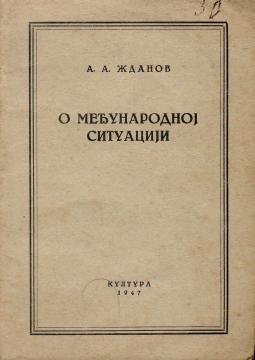
O međunarodnoj situaciji
A. A. Zhdanov's report from the founding meeting of the Informbiro (Poland, September 1947) on the division of the world into two camps – imperialist (USA) and anti-imperialist (USSR). A key document of the beginning of the Cold War.
On the International Situation by Andrei Aleksandrovich Zhdanov (1896–1948) was published in 1947 by the publishing house "Kultura" Belgrade–Zagreb. It is a Croatian-Serbian (Ekavian) translation of a report that Zhdanov gave at the secret Information Conference of representatives of nine European communist parties in Szklarska Poręba (Poland) at the end of September 1947. The booklet is one of the most important political documents of the early post-war period and marks the formal beginning of the Cold War and the establishment of the Informbir (Cominform).
In the report, Zhdanov, then one of Stalin's closest associates and the chief ideologist of the SKP(b), presents the thesis of the division of the world into two irreconcilable camps:
- the imperialist and anti-democratic camp led by the United States of America (along with Great Britain), which strives for world domination, militarization and the suppression of socialism;
- anti-imperialist and democratic camp led by the Soviet Union, which defends peace, people's democracy and socialist development.
Ždanov harshly criticizes the Marshall Plan as an instrument of American economic and political subjugation of Europe, condemns the "opportunism" of Western European communist parties (especially French and Italian) and calls for tighter coordination and ideological purity of the communist movement. The text is a classic example of Ždanovism – a harsh, dogmatic, black-and-white depiction of world relations.
The issue of "Kulture" appeared at a time when Yugoslavia was still firmly attached to the USSR (before the 1948 conflict). The booklet had great propaganda significance and served for the ideological guidance of Yugoslav communists. After the Resolution of the Informbiro in 1948, such editions were quickly withdrawn and banned in Yugoslavia, which makes this copy relatively rare and sought after by collectors.
Zhdanov's report is a key historical document for understanding the beginning of the bloc division of Europe, the creation of the Cominform, and the subsequent Yugoslav-Soviet conflict. The style is typical of Soviet political propaganda of the time: categorical, agitative, and devoid of any nuance.
One copy is available