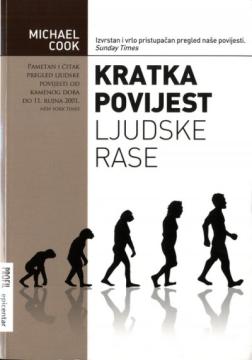
Kratka povijest ljudske rase

Kratka povijest ljudske rase

Michael Cook

Michael A. Cook, Princeton professor of Islamic history, provides an overview of human history from the Neolithic to the fall of the Twin Towers in 2001 in this witty and intelligent synthesis, asking the key question: why did everything happen exactly th

Instead of linear storytelling, Cook jumps through eras, emphasizing the eccentric diversity and gradual unification of human culture - from the agricultural revolution that gives birth to civilizations, through empires (Egypt, China, Rome, Islam), to European expansion and modern globalism.

The book is divided into thematic sections: demography, technology, religion and politics as drivers of change. Cook emphasizes coincidences and inevitable trends - why did Europe dominate and Asia lag behind? – using examples such as the Mongol conquests, the Islamic Golden Age and industrial capitalism. With irony and depth, he analyzes how disease, trade and ideas connected the continents, creating a "single" race in the midst of chaos.

It is a work of dense ideas, ideal for those who want a global view without dryness - short but deep, it reminds us that the human story is a story of resilience and contradictions.

Original title
A Brief History of Human Race
Translation
Ivan Buljan
Editor
Stjepan Ravić
Dimensions
21 x 15 cm
Pages
414
Publisher
Profil Knjiga, Zagreb, 2009.
 
Latin alphabet. Paperback.
Language: Croatian.

One copy is available

Condition:Used, excellent condition
Discounted price: 16.2811.40
30% discount is valid until 5/28/26 11:59 pm
 

Are you interested in another book? You can search the offer using our search engine or browse books by category.

You may also be interested in these titles

Drevni tragovi: Tajne drevne povijesti i pretpovijesti

Drevni tragovi: Tajne drevne povijesti i pretpovijesti

Michael Baigent

In the book Ancient Traces, New Zealand author Michael Baigent (co-author of the bestseller Holy Blood, Holy Grail) presents the provocative thesis that the official history of humanity is incomplete and that there is a hidden, much older layer of civiliz

Stari grad, 2005.
Croatian. Latin alphabet. Hardcover.
15.2210.65 - 15.44
Egipat: Hramovi, ljudi i bogovi

Egipat: Hramovi, ljudi i bogovi

Alberto Siliotti

This richly furnished monograph, with its impressive drawings and photographs and precise and easy-to-understand language, provides a comprehensive and clear account of Egyptian civilization and its achievements.

Mozaik knjiga, 1999.
Croatian. Latin alphabet. Hardcover with dust jacket.
24.3621.92
Grčko čudo

Grčko čudo

Vojtech Zamarovsky

A comprehensive work that explores the extraordinary development of ancient Greek civilization and its lasting influence on Western culture. The author analyzes in detail various aspects of Greek society to demonstrate the uniqueness and significance of t

Školska knjiga, 1978.
Croatian. Latin alphabet. Hardcover.
32.64
Ciklus svemirskih katastrofa: Potopi, požari i skapavanja u povijesti civilizacije

Ciklus svemirskih katastrofa: Potopi, požari i skapavanja u povijesti civilizacije

Richard Firestone, Allen West, Simon Warwick-Smith

The book is the most readable and complete overview of the evidence that human civilization has already been nearly wiped out of the universe once – and that such cycles may repeat themselves every few tens of thousands of years.

Stari grad, 2007.
Croatian. Latin alphabet. Hardcover.
21.2214.87 - 21.3421.28
Opuscula archaeologica IV: Zlatni nakit iz helenističko-ilirske nekropole u Budvi

Opuscula archaeologica IV: Zlatni nakit iz helenističko-ilirske nekropole u Budvi

Duje Rendić-Miočević

The article presents a classic analysis of archaeological findings from the Hellenistic period (3rd-2nd century BC) in the necropolis north of ancient Budva (today's Montenegro), discovered in the 1950s.

Filozofski fakultet Sveučilišta u Zagrebu, 1959.
Croatian. Latin alphabet. Paperback.
9.36