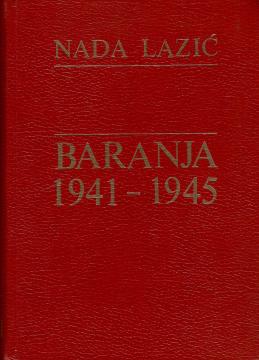
Baranja 1941-1945

Baranja 1941-1945

Nada Lazić

The monograph "Baranja 1941–1945" is the first systematic study of the history of Baranja during World War II. A detailed account of the Hungarian occupation, terror, resistance and liberation of this area.

After the Axis attack on the Kingdom of Yugoslavia in April 1941, Baranja was annexed by Hungary (Horthy's regime), along with Bačka, Međimurje and Prekmurje. The area was annexed to Hungary under the name "Southern Territories" (Délvidék). The book deals in detail with the political, social and military conditions under Hungarian occupation.

The author describes the policy of Magyarization, the repression of the Serbian, Jewish and Croatian population, mass murders and internments, as well as the economic exploitation of the area. Special attention is paid to the development of anti-fascist resistance, the activities of partisan units in the Baranja region, cooperation with liberation movements in Slavonia and Vojvodina and the final liberation in the autumn of 1944 and early 1945 (Battle of Batina, etc.).

The book is based on archival materials, party documents and testimonies, and is written in the spirit of Yugoslav socialist historiography — with an emphasis on the class struggle and heroism of the national liberation movement. Despite its ideological framework, it remains an important and fundamental work on the war history of Baranja because it fills a large gap in regional historiography.

Graphics design
Vladanka Mrkonja
Dimensions
22 x 15 cm
Pages
348
Publisher
Historijski institut Slavonije, Slavonski Brod, 1979.
 
Latin alphabet. Hardcover.
Language: Croatian.

Two copies are available

Copy number 1

Condition:Used, excellent condition

Copy number 2

Condition:Used, excellent condition
Specificity of this instance:
Dedication
 

Are you interested in another book? You can search the offer using our search engine or browse books by category.

You may also be interested in these titles

Erne Kiš 1909-1941

Erne Kiš 1909-1941

Nada Lazić

Biography of revolutionary Erno Kiš (1909–1941), a prominent communist and anti-fascist from Baranja-Bačka. An account of his life, political struggle and suffering on the eve and at the beginning of World War II.

OK SKH, 1984.
Croatian. Latin alphabet. Hardcover.
9.76
Osječka groblja

Osječka groblja

Stjepan Sršan

The book is deeply rooted in the local history and culture of Osijek, with an emphasis on cemetery motifs that serve as a metaphor for memory, death, and disappearance.

Povijesni arhiv u Osijeku, 1996.
Croatian. Latin alphabet. Paperback.
5.26
Važnost nalaza ranosrednjovjekovnog koplja u Varaždinu

Važnost nalaza ranosrednjovjekovnog koplja u Varaždinu

Željko Tomičić
Jugoslavenska akademija znanosti i umjetnosti (JAZU), 1968.
Croatian. Latin alphabet. Paperback.
4.983.49
Hrvati koji su stvarali Europu

Hrvati koji su stvarali Europu

Ivan Tanta

The book collects short biographies of thirty Croatians who, through their work in various fields of science, art and society, have made a contribution to European history.

Stari grad, 2003.
Croatian. Latin alphabet. Hardcover.
6.72 - 6.82
Mass killing and genocide in Croatia 1991/92

Mass killing and genocide in Croatia 1991/92

Hrvatska sveučilišna naklada, 1992.
English. Latin alphabet. Hardcover.
12.989.74
Hrvatsko-makedonski odnosi kroz stoljeća

Hrvatsko-makedonski odnosi kroz stoljeća

Blagoja Jovanovski
Zajednica Makedonaca u Republici Hrvatskoj, 2002.
Croatian. Latin alphabet. Paperback.
3.50