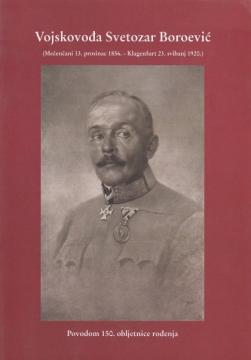
Vojskovođa Svetozar Boroević 1856-1920.

Vojskovođa Svetozar Boroević 1856-1920.

Milan Pojić

Svetozar Boroević, the most capable Austro-Hungarian military leader of the First World War, the only Croat who received the title of field marshal and was awarded the highest Austrian decorations, has been systematically hushed up in Croatian history.

"Ignorance of the basic facts about Svetozar Boroević, and even more the assessment of his person and works by the politicians of the subsequent state formations in which Croatia found itself, from monarchist to socialist Yugoslavia, turned the great military leader and Croatian patriot into a victim of stereotypes. The first, and a similar fate followed ban Josip Jelačić for a long time, is that Boroević is more of an imperial/Austro-Hungarian general and military leader, and less of a "Croatian/Yugoslav patriot". He cares more about the salvation of the Monarchy than about the interests of the Croatian homeland and the Croatian people. Another stereotype is that he was born into an Orthodox border family, so he is therefore a Serb. This stereotype, which was very successfully promoted by the Serbian Orthodox Church and accepted by the wider Croatian public, led to the fact that in the last biography of Boroević published in 1989 in the Croatian Biographical Lexicon, the Miroslav Krleža Lexicographic Institute in Zagreb considered it necessary to mention that Boroević was "of origin is from a Serbian border family". None of the above stereotypes is correct."

Translation
Danijela Marjanić
Dimensions
24 x 17 cm
Pages
31
Publisher
Hrvatski državni arhiv, Zagreb, 2006.
 
Latin alphabet. Paperback.
Language: Croatian.

One copy is available

Condition:Used, excellent condition
 

Are you interested in another book? You can search the offer using our search engine or browse books by category.

You may also be interested in these titles

Stjepan Radić

Stjepan Radić

The Stjepan Radić exhibition catalogue, published in 1991 on the occasion of the exhibition at the Croatian History Museum in Zagreb, is dedicated to the life and work of Stjepan Radić (1871–1928), a key figure in Croatian politics and the founder of the

Hrvatski povijesni muzej, 1991.
Croatian. Latin alphabet. Paperback.
6.42
Predturska povijest Našica

Predturska povijest Našica

Julije Jančula

The book about the pre-Turkish history of Našice, written by abbot Julije Jančula, deals exclusively with that specific period of Slavonian and Našić history.

Zavičajni muzej Našice, 1996.
Croatian. Latin alphabet. Paperback.
4.88
Hrvatski duh Alke: simbolika i filozofija hrvatske povijesti

Hrvatski duh Alke: simbolika i filozofija hrvatske povijesti

Petar Vučić

Through Sinj's Alka, the entirety of the Croatian ethnic and ethical being is encompassed.

Consilium, 1998.
Croatian. Latin alphabet. Paperback.
5.624.50
Pregled povijesti hrvatskoga naroda

Pregled povijesti hrvatskoga naroda

Ferdo Šišić
Nakladni zavod Matice hrvatske, 1975.
Croatian. Latin alphabet. Hardcover with dust jacket.
9.32 - 11.769.41
Jugoslavenske vlade u izbjeglištvu 1941-1943

Jugoslavenske vlade u izbjeglištvu 1941-1943

Bogdan Krizman, Branko Petranović

A two-volume work that documents the activities of Yugoslav governments in exile during World War II. The study represents a significant contribution to the study of the history of political processes during World War II.

Globus, 1981.
Croatian. Latin alphabet. Hardcover with dust jacket.
The book consists of two volumes
12.99
Rimokatolička crkva i radničko pitanje u Hrvatskoj 1869-1914

Rimokatolička crkva i radničko pitanje u Hrvatskoj 1869-1914

Vinko Cecić
NIP, 1957.
Croatian. Latin alphabet. Hardcover with dust jacket.
4.993.74