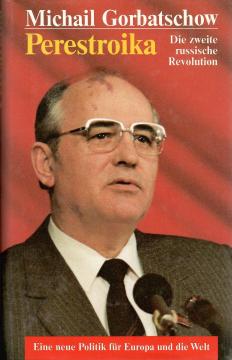
Perestroika: Die zweite russische Revolution - Eine neue Politik für Europa und die Welt

Perestroika: Die zweite russische Revolution - Eine neue Politik für Europa und die Welt

Mihail S. Gorbačov

In the book, Mikhail Gorbachev explains perestroika as the second Russian revolution – a reform of Soviet society, economy and international politics. He advocates openness (glasnost), democracy and new cooperation with the West.

Perestroika: The Second Russian Revolution – A New Policy for Europe and the World is a programmatic book by Mikhail Gorbachev, the then General Secretary of the CPSU. It was published at a time when his reforms were in full swing and represents the official vision of changes in the Soviet Union and the world. The book became an international bestseller and an important document of the end of the Cold War.

Gorbachev presents perestroika (restructuring) as a necessary second Russian revolution that should overcome the stagnation of the Brezhnev era. He criticizes bureaucracy, corruption and the inefficiency of the planned economy and advocates the introduction of elements of a market economy: the independence of enterprises, limited private initiative and a greater role for science and technology. At the same time, he emphasizes that perestroika is not an abandonment of socialism, but its improvement – ​​socialism with a human face.

Along with economic reform, glasnost (openness) – freedom of speech, transparency and democracy within the party and society – takes center stage. Gorbachev believes that without public discussion and criticism there is no real progress. The book also deals with international politics: new thinking (new thinking) rejects Cold War confrontation and advocates world interdependence, disarmament, cooperation with the West and solving global problems (ecology, poverty). Gorbachev sees Europe and the world as a unique space where socialism and capitalism can peacefully coexist and learn from each other.

The style of the book is clear, convincing and optimistic. Gorbachev writes as a visionary and pragmatist who wants the West to understand him, but also as a faithful Marxist-Leninist who believes in the restoration of socialism. The book contains personal reflections, historical analyzes and specific proposals for reforms.

Today, perestroika and glasnost are seen as key processes that led to the fall of the Berlin Wall, the end of the Cold War, and the collapse of the USSR in 1991—outcomes that Gorbachev did not want but that his reforms indirectly made possible. The book remains an important historical document: a testimony to the hopes, illusions and tragedy of the last attempt to reform the Soviet system. It is valuable to readers because it shows first-hand the inner logic of Gorbachev's policies—a mixture of idealism, pragmatism, and the limitations of the system he tried to change.

Original title
Perestroika: New Thinking for Our Country and the World
Translation
Gabriele Burkhardt, Reiner Pfleiderer, Wolfram Strole
Editor
Brigitta Neumeister-Taroni
Dimensions
21.5 x 13.5 cm
Pages
343
Publisher
Bertelsmann Lesering, Gütersloh, 1987.
 
Latin alphabet. Hardcover with dust jacket.
Language: German.

One copy is available

Condition:Unused
 

Are you interested in another book? You can search the offer using our search engine or browse books by category.

You may also be interested in these titles

Izabrani radovi

Izabrani radovi

Ljubo Boban

Selected Works of Academician Ljubo Boban (2022) brings together key texts on contemporary Croatian history of the 20th century. The foreword by Damir Agičić highlights Boban's methodological rigor and objectivity in researching sensitive topics.

Srednja Europa, 2022.
Croatian. Latin alphabet. Hardcover.
24.52
Mein Kampf / Moja borba

Mein Kampf / Moja borba

Adolf Hitler

Hitler's book combines autobiography and political manifesto, laying the foundations of Nazi ideology. The work has been banned in many countries for promoting hatred, but it remains a historical document that reveals the origins of Nazi crimes.

Kvrga izdavaštvo, 1999.
Croatian. Latin alphabet. Hardcover.
27.00
Svi Staljinovi ljudi

Svi Staljinovi ljudi

Roj Medvedev

Roj Medvedev's book is a collection of biographical portraits of six key collaborators of Joseph Stalin: Vyacheslav Molotov, Lazar Kaganovich, Anastasij Mikoyan, Kliment Voroshilov, Georgi Maljenkov and Mikhail Suslov.

Svjetlost, 1987.
Croatian. Latin alphabet. Hardcover.
11.348.50
Projekt Guevara: Snovitim stazama svjetske revolucije

Projekt Guevara: Snovitim stazama svjetske revolucije

Gerd Koenen

This book is a biography of the historical figure and icon of the twentieth century, Ernesto Che Guevara - in light of his project of a world revolution, which Koenen, after Bruce Chatwin, will call dream paths.

Durieux, 2011.
Croatian. Latin alphabet. Hardcover with dust jacket.
17.6213.22
Sudbonosni podvig Jugoslavije: Podsjećanje na historijsko NE staljinizmu, događaj koji je opredijelio budućnost Jugoslavije

Sudbonosni podvig Jugoslavije: Podsjećanje na historijsko NE staljinizmu, događaj koji je opredijelio budućnost Jugoslavije

Raif Dizdarević

The book by Raif Dizdarević, one of the last living actors of Yugoslav diplomacy, presents his reconstruction of the most fateful moment of post-war Yugoslavia – the split with Stalin and the Informburo in 1948–1953.

Udruženje za modernu historiju (UMHIS), 2018.
Croatian. Latin alphabet. Paperback.
23.58
Kroz tajni arhiv Udbe

Kroz tajni arhiv Udbe

Nikola Milovanović

The author of this book describes the fate of the main enemies of the Yugoslav communists in the last stage of the war, as well as their attempts to prevent the consolidation of communist power in Yugoslavia in the first post-war years.

Sloboda, 1986.
Croatian. Latin alphabet. Hardcover with dust jacket.
The book consists of two volumes
15.26