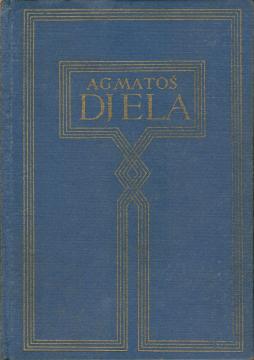
Djala 9: Pečalba - Kaprisi i feljtoni
Book of Works 9: Pečalba – Caprices and Feuilletons is a collection of caprices, feuilletons and satirical writings with sharp criticism of society, irony, humor and Matoš's bohemian, polemical spirit.
Pečalba – Caprices and Feuilletons (1939, edited by Julije Benešić) is the ninth volume in the 17-volume critical edition of the Works of A. G. Matoš (1935–1940). The literary legacy was collected by Milan Matoš, and for this volume, Julije Benešić took over the editorial office. The texts are arranged philologically, with notes on previous publications. The collection brings together Matoš's caprices (capricious, witty and subjective notes) and feuilletons — short, topical, satirical and polemical forms in which his journalistic and literary talent is expressed.
The title Pečalba is symbolic: it reflects Matoš's life as a professional writer in constant poverty, his “pečalba” departure abroad (Belgrade, Paris) and his struggle for survival in his homeland. Caprices and Feuilletons bring a variety of themes — satire on Croatian society, politics, literary rivals, petty bourgeoisie and decadence, with humorous, ironic and self-reflexive writings. Matoš shows himself here as a master of the short form: witty, biting, but also lyrically sensitive.
The style is fast, concise and effective — typically feuilletonistic, with rich language, allusions and unexpected turns. The feuilletons often turn into literary criticism or social diagnosis, while the caprices have a more personal, whimsical tone. The collection reflects Matoš's bohemian life, constant polemics and disappointment in Croatian conditions, but also his vitality, wit and love of art.
In the context of the entire edition, the ninth volume continues on the travelogues, impressions and criticisms, showing Matoš as an engaged publicist. Benešić's edition preserved these texts that were scattered throughout newspapers during his lifetime. Today, Pečalba is read as a testimony to the difficult position of the Croatian intellectual at the beginning of the 20th century, but also as the pinnacle of Matoš's satirical and humorous prose. Kaprisi i feuilletoni highlight his ability to transform current topics into lasting literature — sharp, entertaining and deeply human.
This collection is indispensable for a full understanding of Matoš's oeuvre: it demonstrates the diversity of his talent (from lyric poetry and short stories to journalism) and his tireless critical spirit. It is also valuable as a historical document of the cultural and social life of Croatia on the eve of the First World War.
One copy is available