Zadarski kalendar iz benediktinskog samostana svetog Krševana (1322.)
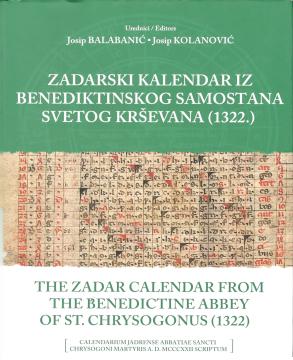
The monograph by Josip Balabanić and Josip Kolanović provides a comprehensive overview, transcription and analysis of the Zadar Calendar from 1322, an exceptional monument of Croatian and European scientific heritage.
The scientific monograph "Zadar Calendar from the Benedictine Monastery of St. Chrysostom (1322)", edited by Dr. sc. Josip Balabanić and Dr. sc. Josip Kolanović, represents the first complete treatment and critical edition of an exceptionally important medieval manuscript. The manuscript was created in the scriptorium of the Zadar Benedictines in June 1322, but shortly after its compilation it was taken from Zadar and has been kept in the famous Bodleian Library of the University of Oxford since 1605 (under the designation MS Canonici Liturgici 277).
The original manuscript was written on parchment leaves and contains a total of six leaves, or twelve pages of dense text and tables. In terms of content, it combines the liturgical calendar and the scientific-astronomical part. In addition to the Christian martyrology and holidays specific to the Zadar Church (such as the commemoration of St. Chrysostom, St. Anastasia and St. Zoila), the codex provides exceptionally advanced astronomical calculations.
It represents the oldest preserved astronomical text in Croatia and the first written document in Croatian with ephemeris data (tables of the movements of the Sun and Moon) and the earliest systematic use of Arabic numerals. In addition to Arabic numerals, Roman numerals are also used in the manuscript, and the calendar offers calculations of equinoxes, solstices, and the determination of movable holidays.
This richly equipped monograph brings a complete facsimile of the original in color, transcription and translation from Latin, and extensive studies that prove the high level of natural science literacy in 14th-century Zadar and its direct integration into European scientific trends.
One copy is available