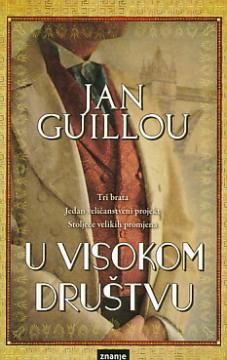
U visokom društvu

U visokom društvu

Jan Guillou

The third part of Jan Guillou's historical saga. We follow the Lauritzen family during the 1930s, when the rise of Nazism in Germany brings dangerous ideological and emotional rifts into their privileged lives.

"In High Society" is the third installment of the grandiose historical saga "The Magnificent Century" by the celebrated Swedish writer Jan Guillou. The novel is set in the turbulent 1930s and covers the period from Adolf Hitler's rise to power to the very beginning of World War II, following the further fate of the wealthy and influential Lauritzen family. The story centers on the eldest brother Lauritz, who lives in high society in Sweden and Berlin, remaining blind to the increasingly dangerous political turmoil in Germany due to his own fascination with German culture and class privileges. His children, growing up in high society, take completely opposite positions: daughter Johanna joins the anti-fascist resistance movement in Norway, while son Harald becomes fascinated by Nazi ideology and joins the SS. Through these stark family polarizations, Guillou masterfully depicts how ideological fanaticism and the impending catastrophe of war destroy the strongest family ties, and how members of the upper class grapple with moral dilemmas in a time of total collapse of humanity. Written in extraordinary detail, with a deep understanding of historical context, political economy, and social relations, "In High Society" is a thrilling and instructive chronicle of Europe's twilight era and an impressive achievement of contemporary historical fiction.

Original title
Dandy
Translation
Sara Profeta
Editor
Silvia Sinković
Graphics design
Janka Carev
Dimensions
19 x 12 cm
Pages
282
Publisher
Znanje, Zagreb, 2015.
 
Latin alphabet. Paperback.
Language: Croatian.

One copy is available

Condition:Used, excellent condition
 

Are you interested in another book? You can search the offer using our search engine or browse books by category.

You may also be interested in these titles

Odsustvo do buđenja

Odsustvo do buđenja

Leon Uris

Battle Cry (1953) is Leon Uris's debut novel based on his experience in World War II as a member of the 6th Marine Regiment.

Otokar Keršovani, 1970.
Croatian. Latin alphabet. Hardcover with dust jacket.
8.24
Vergilijeva smrt

Vergilijeva smrt

Hermann Broch

The Death of Virgil (1945) is Hermann Broch's most famous work. The novel follows the final days of the Roman poet Publius Virgilius Marus, who, gravely ill, travels from Athens to Brundisium, arriving on the birthday of Emperor Augustus in 19 AD.

Svjetlost, 1982.
Croatian. Latin alphabet. Hardcover.
6.99
Noć

Noć

Edgar Hilsenrath

A poignant novel describing life in a Jewish ghetto in Ukraine, based on the author's experience as a Holocaust survivor. Set in the fictional town of Prokov, the novel follows the inhabitants of the ghetto, especially Raneko, as they struggle to survive.

August Cesarec, 1982.
Croatian. Latin alphabet. Hardcover with dust jacket.
6.58
Travnička hronika: Konsulska vremena

Travnička hronika: Konsulska vremena

Ivo Andrić

"The Travnik Chronicle" (1945) is a historical story set in Travnik from 1807 to 1814, during the Napoleonic Wars and Ottoman rule in Bosnia. Written during World War II, it is modeled after the European realist novel.

Mladost, 1962.
Serbian. Latin alphabet. Paperback.
8.35
Pile na ražnju

Pile na ražnju

Jiří Šotola

Jiří Šotola's quasi-historical novel Pile on a Spit depicts the absurdity of life through the story of the antihero – the puppeteer Matija Pile (Matěj Kuře), a puppeteer of history during the Napoleonic Wars. The novel criticizes totalitarianism through b

August Cesarec, 1983.
Croatian. Latin alphabet. Hardcover with dust jacket.
4.82 - 4.84
Dvanaestorica protiv bogova

Dvanaestorica protiv bogova

William Bolitho
NIP, 1960.
Croatian. Latin alphabet. Hardcover with dust jacket.
4.60