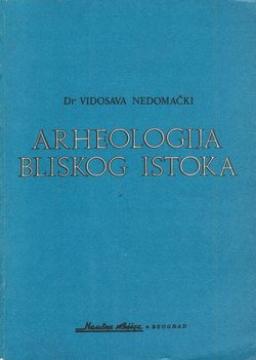
Arheologija Bliskog istoka

Arheologija Bliskog istoka

Vidosava Nedomački

The manual of Vidosave Nedomáčki is a detailed overview of the cradle of civilization. Covers the material culture, architecture and art of ancient Mesopotamia, Egypt, the Levant and Persia from prehistory to antiquity.

The book Archaeology of the Near East (1981) by Dr. Vidosava Nedomački is a seminal work in the Croatian/Serbian language within the field of Near Eastern archaeology; it has long served as a university textbook and remains essential reading for students of archaeology, history, and art history. The work provides a comprehensive and systematic overview of the archaeological finds, cultures, and civilizations that developed in the Near and Middle East—a region rightly considered the cradle of human civilization. The author guides the reader—both chronologically and thematically—through key periods: from the Neolithic Revolution and the first sedentary communities, through the emergence of writing, monumental architecture, and the first city-states, to the powerful empires of antiquity. The regions of Mesopotamia (Sumer, Akkad, Babylon, Assyria), Ancient Egypt, the Levant (Canaan, Phoenicia, Palestine), as well as Asia Minor and Persia, are covered in detail. Through an analysis of architecture, sculpture, pottery, burial finds, and craft objects, Vidosava Nedomački elucidates the social, religious, and economic structures of ancient peoples. The book is distinguished by its scholarly precision, rich descriptions of archaeological sites, and a clear presentation of the influence Near Eastern cultures exerted on the development of Mediterranean and European civilizations.

Dimensions
24 x 17 cm
Pages
171
Publisher
Naučna knjiga, Beograd, 1981.
 
Distribution: 1,000 copies
 
Latin alphabet. Paperback.
Language: Serbian.

One copy is available

Condition:Used, excellent condition
 

Are you interested in another book? You can search the offer using our search engine or browse books by category.

You may also be interested in these titles

Tutankhamon: Kralj u zlatnim kovčezima

Tutankhamon: Kralj u zlatnim kovčezima

Otto Neubert

The author, one of the living eyewitnesses of the excavations in the Valley of the Kings, provides the reader with a popular-scientific picture not only of one of the most famous ancient Egyptian rulers, but also of the most interesting facts of the ethno

Stvarnost, 1977.
Croatian. Latin alphabet. Hardcover.
8.56
Nalazište mlađeg željeznog doba s terena Osijeka (nastavak)

Nalazište mlađeg željeznog doba s terena Osijeka (nastavak)

Emil Spajić

The study analyzes the Celtic necropolis in Osijek, revealing the simultaneous use of cremation and burial of the deceased. The findings indicate strong Celtic and Illyrian cultural influences and developed metal production.

Muzej Slavonije, 1962.
Croatian. Latin alphabet. Paperback.
11.32
Poreklo Slovena: Osvrti na DNK-genealogiju

Poreklo Slovena: Osvrti na DNK-genealogiju

Anatolij A. Kljosov

Anatoly A. Klyosov's book The Origin of the Slavs - A Look at DNA Genealogy uses DNA genealogy methods to reconstruct the origins of the Slavs, Serbs, and Russians, challenging traditional theories of migration in the 6th century.

Miroslav, 2013.
Serbian. Cyrillic alphabet. Hardcover.
34.26
Ukrajinski Karpati: Etnogeneza, arheologija, etnologija

Ukrajinski Karpati: Etnogeneza, arheologija, etnologija

The collection is an interdisciplinary bridge between Ukrainian and Croatian science, encouraging comparative research on Slavic migrations. It presents the Carpathians as a "living archipelago" connecting East and West, important for Croatian ethnogenesi

Filozofski fakultet Sveučilišta u Zagrebu, 2014.
Croatian. Latin alphabet. Paperback.
18.34
Uništenje Atlantide: Uvjerljiv dokaz o iznenadnoj propasti legendarne civilizacije

Uništenje Atlantide: Uvjerljiv dokaz o iznenadnoj propasti legendarne civilizacije

Frank Joseph

Frank Joseph (real name Francis Joseph Collin) presents in this book the most comprehensive modern defense of Plato's Atlantis as a real historical civilization that disappeared in a catastrophe around 1628–1600 BC.

Stari grad, 2004.
Croatian. Latin alphabet. Hardcover.
15.2410.67 - 15.2810.70
Prilozi Instituta za arheologiju u Zagrebu

Prilozi Instituta za arheologiju u Zagrebu

Contributions of the Institute of Archeology in Zagreb, Vol. 24 No. -, 2007

Institut za arheologiju, 2007.
Croatian. Latin alphabet. Paperback.
7.98