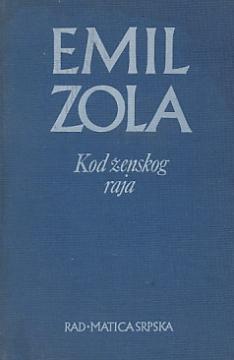

Kod ženskog raja

Kod ženskog raja

Émile Zola
Original title
Au bonheur des dames
Translation
Mirjana Lalić
Editor
Dušan Papadopolos
Graphics design
Stevan Vujkov
Dimensions
20 x 14 cm
Pages
464
Publisher
Rad, Beogard, 1974.
 
Distribution: 20,000 copies
 
Latin alphabet. Hardcover.
Language: Serbian.

No copies available

The last copy was sold recently.

 

Are you interested in another book? You can search the offer using our search engine or browse books by category.

You may also be interested in these titles

Zver-čovek

Zver-čovek

Émile Zola

The novel explores the destructive forces of inheritance, passion, and violence in modern industrial society. The action takes place largely on the railroad, a symbol of speed, destiny, and inevitable doom. “Beast Man” is the first description of crime in

Nolit, 1940.
Serbian. Latin alphabet. Paperback with dust jacket.
56.32
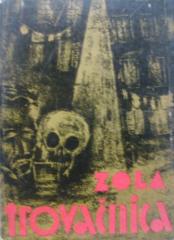
Trovačnica

Trovačnica

Émile Zola

The novel The Poisoner was published in sequels during 1876, and in book form in 1877. It is the story of a woman's struggle for happiness in the working class of Paris.

Rad, 1955.
Serbian. Latin alphabet. Hardcover with dust jacket.
8.62 - 9.99
Stranica ljubavi

Stranica ljubavi

Émile Zola
Rad, 1974.
Serbian. Latin alphabet. Hardcover.
5.84
Proces

Proces

Franz Kafka

Kafka wrote The Process between 1914 and 1915, published posthumously in 1925. The novel is unfinished but with an added final chapter by Max Brod. Edition with a foreword by B. Živojinović and an afterword by Walter Killi.

BIGZ, 1990.
Serbian. Latin alphabet. Paperback.
4.26
Usta puna zemlje

Usta puna zemlje

Branimir Šćepanović

The novel "Usta puna zemlje" (1970), the masterpiece of the Serbian writer Branimir Šćepanović, is a psychologically in-depth explorer of the limits of the human soul, solitude and existential freedom, reminiscent of Kafka and Camus.

BIGZ, 1987.
Serbian. Latin alphabet. Paperback.
3.98
Zagrepčanka

Zagrepčanka

Branislav Glumac

Branislav Glumac published a novel without periods or commas in 1974, as the relentless stream of thought of a young rebel. Published in socialist Yugoslavia, the work caused a scandal with its openness and became a classic about generational rebellion.

IROS, 1986.
Croatian. Latin alphabet. Hardcover.
8.24