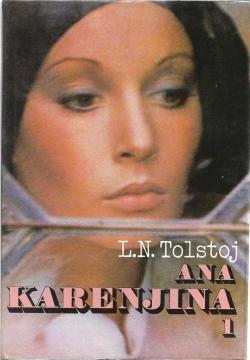
Ana Karenjina

Ana Karenjina

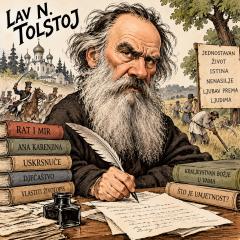
Lav Nikolajevič Tolstoj
Tolstoj

As one of Tolstoy's greatest novels, the work combines psychological depth, realistic depiction of society, and philosophical themes. Anna is a literary icon, and the novel is a bridge between early realism and later moral reflections.

In 19th-century Russia, Anna Karenina, the beautiful and respected wife of high-ranking official Alexei Karenin, lives a seemingly perfect life. But a passionate affair with a young officer, Vronsky, changes everything. Anna Karenina (1875-1877), Leo Nikolayevich Tolstoy’s masterpiece, explores love, morality, and social norms.

Anna, trapped in a cold marriage, succumbs to her love for Vronsky. Their affair causes a scandal, and Anna abandons her husband and son, facing societal condemnation. As she struggles with jealousy and despair, her life descends into chaos. Vronsky, though in love, cannot satisfy her need for security. In parallel, the story follows Levin, a nobleman who searches for meaning in village life and his love for Kitty. His search for spiritual balance contrasts with Anna’s tragic fate. While Anna slides toward despair, Levin finds peace in family and faith.

The novel ends tragically for Anna, whose death symbolizes the impossibility of reconciling passion and social expectations. Levin, on the other hand, reveals a deeper meaning through simplicity and spirituality. Anna Karenina explores love, guilt, and the search for happiness, criticizing the hypocrisy of aristocracy and patriarchal norms.

As one of Tolstoy's greatest novels, the work combines psychological depth, realistic depiction of society, and philosophical themes. Praised for its style and complexity of characters, the novel gained immediate fame, although some criticized it for its length. Today, it is a masterpiece of world literature.

Translation
Krunoslav Pranjić
Editor
Jakša Kušan
Graphics design
Alfred Pal
Dimensions
20 x 14 cm
 
The book consists of two volumes.
Pages total
893
Publisher
Nakladni zavod Matice hrvatske, Zagreb, 1979.
 
Latin alphabet. Hardcover with dust jacket.
Language: Croatian.

No copies available

The last copy was sold recently.
 

Are you interested in another book? You can search the offer using our search engine or browse books by category.

You may also be interested in these titles

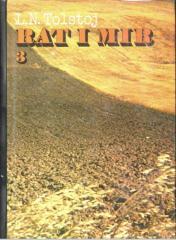
Rat i mir 3

Rat i mir 3

Tolstoj
Lav Nikolajevič Tolstoj
Nakladni zavod Matice hrvatske, 1979.
Croatian. Latin alphabet. Hardcover with dust jacket.
5.98 €
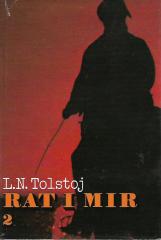
Rat i mir 2

Rat i mir 2

Tolstoj
Lav Nikolajevič Tolstoj
Nakladni zavod Matice hrvatske, 1979.
Croatian. Latin alphabet. Hardcover with dust jacket.
5.98 €
Djetinjstvo / Dječaštvo / Mladost

Djetinjstvo / Dječaštvo / Mladost

Tolstoj
Lav N. Tolstoj

Leo Nikolayevich Tolstoy, in his autobiographical trilogy Childhood (1852), Boyhood (1854), and Youth (1857), follows the growing up of Nikolai Irtenyev, a young nobleman whose experience mirrors Tolstoy's own youth.

Nakladni zavod Matice hrvatske, 1979.
Croatian. Latin alphabet. Hardcover with dust jacket.
5.70 €
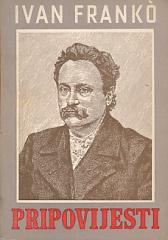
Pripovijesti

Pripovijesti

Ivan Franko

Contents: Bricklayer, Good earnings, Forests and pastures, Gypsies, On the light, Lady's bread, Note about the writer

Zora, 1950.
Croatian. Latin alphabet. Paperback.
2.96 - 2.98 €
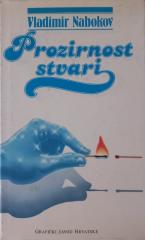
Prozirnost stvari

Prozirnost stvari

Vladimir Nabokov

Behind the ironic-humorous style with which he portrays Hugh Person, the hero of the novel, Nabokov weaves a serious human drama.

Grafički zavod Hrvatske (GZH), 1980.
Croatian. Latin alphabet. Hardcover with dust jacket.
5.98 €
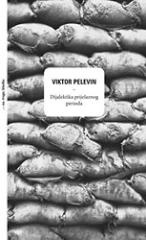
Dijalektika prijelaznog perioda

Dijalektika prijelaznog perioda

Viktor Pelevin

The book represents the author's anthology - the largest part is the novel Čisla (Čisla), followed by the short story Macedonian Criticism of French Thought and several short stories (Odin vog, Akiko, Fokus-grupa, Gost na prazniku bon).

Disput, 2006.
Croatian. Latin alphabet. Paperback.
9.68 €