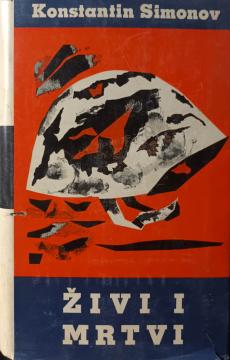
Živi i mrtvi

Živi i mrtvi

Konstantin Simonov

The novel is the first part of Konstantin Simonov's war trilogy, depicting the first years of the Great Patriotic War through the fates of soldiers and civilians, their struggles and attempts to survive the horrors of war.

The novel The Living and the Dead by Konstantin Simonov is one of the most famous Soviet war novels. The plot begins in the summer of 1941, after the German attack on the Soviet Union, when the Red Army is facing heavy defeats and retreating before the enemy.

The main character is Ivan Sinytsov, a war correspondent who suddenly finds himself in the midst of the chaos of war. After losing his family and being forcibly separated from his unit, he joins the army and goes through dramatic experiences on the battlefield. Along with him, an important role is played by General Fyodor Sergeevich Serpilin, a capable and courageous commander who was unjustly killed during the Stalinist purges, and numerous soldiers whose fates show different sides of the war.

Through their stories, Simonov depicts the beginning of the war as a period of confusion, fear and great losses, but also a time in which human courage, loyalty and willingness to sacrifice are demonstrated. He especially emphasizes that war is not determined only by great military decisions, but also by the everyday suffering of ordinary people.

The title of the novel symbolizes those who physically survived the war and those who, although dead, remained alive in the memory and actions of others. Simonov does not portray war simply as a clash of armies, but as a tragedy that changes a person and an entire society.

Original title
Живые и мёртвые
Translation
Vida Flaker
Editor
Aleksandar Flaker
Dimensions
20.5 x 13.5 cm
Pages
556
Publisher
Naprijed, Zagreb, 1966.
 
Latin alphabet. Hardcover with dust jacket.
Language: Croatian.

One copy is available

Condition:Used, excellent condition
 

Are you interested in another book? You can search the offer using our search engine or browse books by category.

You may also be interested in these titles

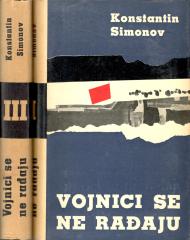
Vojnici se ne rađaju 1-2

Vojnici se ne rađaju 1-2

Konstantin Simonov

Roman „Vojnici se ne rađaju“ Konstantina Simonova prikazuje bitke Crvene armije na Staljingradskom bojištu i prati vojnike i komandante koji sazrevaju kroz ratna iskušenja i postaju pravi ratnici.

Naprijed, 1966.
Croatian. Latin alphabet. Hardcover with dust jacket.
The book consists of two volumes
16.42
Baraka Pet Be i druge novele

Baraka Pet Be i druge novele

Miroslav Krleža

Zbirka „Baraka Pet Be i druge novele“ donosi izbor Krležinih antiratnih romana iz perioda 1916–1920-ih, fokusirajući se na besmislenost Prvog svetskog rata, patnje domobranstva i pad Austro-Ugarske.

Mladost, 1987.
Croatian. Latin alphabet. Hardcover.
5.38
Zmija oko vrata I-II

Zmija oko vrata I-II

Lydia Scheuermann-Hodak

Ratno-psihološka proza smeštena u vreme Domovinskog rata (1991–1995), sa fokusom na Slavoniju i delimično na događaje u Bosni. Delo pripada ciklusu proze o ratu i ženskim iskustvima u njemu.

Grafika, 2004.
Croatian. Latin alphabet. Paperback.
The book consists of two volumes
9.76
Djevojka s Leicom

Djevojka s Leicom

Helena Janeczek

Roman je kaleidoskopski, polifoni prikaz života Gerde Taro (rođene Gerda Pohorile, 1910–1937), prve ratne fotografkinje koja je poginula na bojnom polju. Obavezno štivo za ljubitelje istorijske fikcije o jakim ženama i antifašizmu.

Naklada Ljevak, 2020.
Croatian. Latin alphabet. Hardcover with dust jacket.
13.72
Zbogom oružje

Zbogom oružje

Ernest Hemingway

Hemingwayev roman Zbogom oružje (1929.), smješten na talijansko-austrijskom frontu, prati ljubavnu priču i ratne doživljaje Frederica Henryja, američkog poručnika koji služi kao vozač hitne pomoći u talijanskoj vojsci tijekom Prvog svjetskog rata.

Matica srpska, 1985.
Serbian. Latin alphabet. Hardcover.
4.72
Đavo govori španjolski

Đavo govori španjolski

Zdeněk Němeček

Roman donosi potresnu priču o Španjolskom građanskom ratu. Kroz sudbine novinara, intelektualaca i običnih ljudi prikazuje brutalnost, ideološke sukobe i demonsku stranu rata u kojem „đavo govori španjolski“.

Savremena biblioteka, 1940.
Croatian. Latin alphabet. Hardcover with dust jacket.
3.26 - 11.36