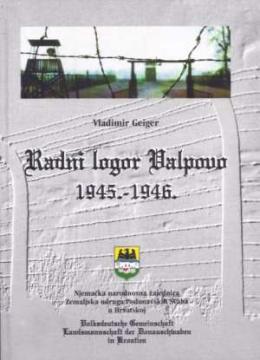
Radni logor Valpovo 1945.-1946.: dokumenti
Rare book

Radni logor Valpovo 1945.-1946.: dokumenti

Vladimir Geiger

The Valpovo labor camp (1945–1946) was the largest camp for Volksdeutschers in Croatia after World War II. About 4,000 Germans and Austrians were interned; at least 1,074 died, mostly from hunger, disease, and exhausting labor.

The Valpovo labor camp operated from May 1945 to May 1946 under the administration of the communist authorities of Yugoslavia (OZN and NOB). It was the largest camp for members of the German national minority (Volksdeutsche) in Croatia and one of the largest in all of Yugoslavia. Located on the premises of the Belje estate and surrounding buildings in Valpovo, the camp was officially intended for "re-education" and forced labor, but in practice it represented a form of collective punishment for the entire German community for collaborating with the Nazi regime during the war.

About 4,000 people were interned, mainly women, children, and elderly men (most able-bodied men had been mobilized or had fled). Camp inmates were forced to perform hard agricultural and other labor with minimal food, poor housing, and inadequate medical care. The result was mass deaths from hunger, typhus, dysentery and exhaustion – at least 1,074 deaths have been reliably documented (some say up to 1,600), and the bodies were mostly buried in mass graves in the Valpovo cemetery or in unmarked graves.

In his book Radni logor Valpovo 1945–1946: dokumenti, historian Vladimir Geiger collected and published archival material – lists of inmates, reports, orders, testimonies and photographs – providing thorough documentation of the conditions, structure of the camp and the number of victims. The book is a key source for studying the persecution of Danubian Swabians and other Volksdeutschers in post-war Yugoslavia, highlighting the systematic discrimination and tragic consequences of collective guilt.

Translation
Marinko Krajnović
Editor
Renata Trišler
Dimensions
30 x 21 cm
Pages
443
Publisher
Njemačka zajednica podunavskih Švaba u Hrvatskoj, Osijek, 1999.
 
Latin alphabet. Hardcover.
Language: Croatian.

No copies available

The last copy was sold recently.
 

Are you interested in another book? You can search the offer using our search engine or browse books by category.

You may also be interested in these titles

Dijalog povjesničara-istoričara 10/2

Dijalog povjesničara-istoričara 10/2

Miroslav Akmadža, Bojan B. Dimitrijević, Vladimir Geiger, Igor Graovac, Filip Škiljan, Marica Kar...
Zaklada Friedrich Naumann, 2008.
Croatian. Latin alphabet. Paperback.
6.99
Vojskovođa Svetozar Boroević 1856-1920.

Vojskovođa Svetozar Boroević 1856-1920.

Milan Pojić

Svetozar Boroević, the most capable Austro-Hungarian military leader of the First World War, the only Croat who received the title of field marshal and was awarded the highest Austrian decorations, has been systematically hushed up in Croatian history.

Hrvatski državni arhiv, 2006.
Croatian. Latin alphabet. Paperback.
5.464.37
Povijest Hrvatske 1945-2011. (2.svezak)

Povijest Hrvatske 1945-2011. (2.svezak)

Ivo Goldstein

Goldstein's "History of Croatia" is one of the most reliable books published in the past period, especially rich in historical works.

EPH media d. o. o., 2011.
Croatian. Latin alphabet. Paperback.
5.223.92
U obrani svjetla : 15 godina Udruge hrvatskih branitelja Hrvatske elektroprivrede 1990. - 1995.

U obrani svjetla : 15 godina Udruge hrvatskih branitelja Hrvatske elektroprivrede 1990. - 1995.

Vlatko Čakširan
24 sata, 2011.
Croatian. Latin alphabet. Hardcover.
9.85
Branimirova Hrvatska u pismima pape Ivana VIII.

Branimirova Hrvatska u pismima pape Ivana VIII.

Mate Zekan
Književni krug, 1989.
Croatian. Latin alphabet. Paperback.
4.39
90 godina samostalne zdravstvene ustanove Dom zdravlja Osijek

90 godina samostalne zdravstvene ustanove Dom zdravlja Osijek

Nefreteta Zekić Eberhard, Miroslav Sikora
Matica hrvatska, 2016.
Croatian. Latin alphabet. Hardcover.
2.50