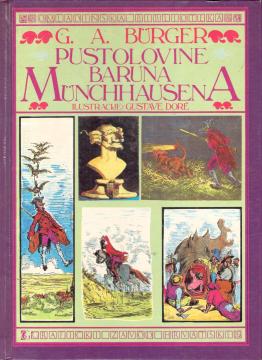
Pustolovine baruna Münchhausena

Pustolovine baruna Münchhausena

Gottfried August Bürger

The Adventures of Baron Münchhausen by Gottfried August Bürger, published in 1786, is a humorous work based on a real person, Baron Hieronymus Karl Friedrich von Münchhausen, known for his exaggerated stories.

Bürger, a German poet, adapted and expanded on earlier versions by Rudolph Erich Raspe, creating a collection of fantastic tales told from the perspective of a baron who boasts of his incredible adventures. Münchhausen recounts absurdly exaggerated adventures: riding on a cannonball, pulling himself out of a swamp by his own hair, traveling to the moon, battling giant crocodiles, and encountering mythical creatures.

The stories are filled with satirical humor, mocking the exaggerations of travel writers and the social pomp of the 18th century. The baron is portrayed as a charming liar whose imagination knows no bounds, and his adventures often defy the laws of physics and logic.

Bürger's style is lively, with an emphasis on the oral tradition of storytelling, which makes the stories dynamic and entertaining. The work criticizes social norms, but also celebrates imagination and the freedom of storytelling. Münchhausen's adventures have become a classic of world literature, inspiring numerous adaptations in films, theater, and literature, and have entered culture as a synonym for fantastic, incredible stories.

Original title
Wunderbare Reisen zu Wasser und zu Lande, Feldzuge and lustige Abenteuer des Freiherrn von Munchhausen wie er dieselben bei der Flasche im Zirkel seiner Freunde zu erzahlen pflegt
Translation
Benjamin Tolić
Editor
Branko Matan
Illustrations
Gustave Dore
Graphics design
Zoran Pavlović
Dimensions
24 x 17 cm
Pages
147
Publisher
Grafički zavod Hrvatske (GZH), Zagreb, 1988.
 
Distribution: 10,000 copies
 
Latin alphabet. Hardcover.
Language: Croatian.
ISBN
8-63-990084-1

No copies available

The last copy was sold recently.
 

Are you interested in another book? You can search the offer using our search engine or browse books by category.

You may also be interested in these titles

Što je muškarac bez brkova: humoristički roman

Što je muškarac bez brkova: humoristički roman

Ante Tomić

When it was first published in 2000, Tomić's novel What is a Man Without a Mustache instantly became a bestseller, and over the next few years it went through a series of new editions, dramatizations, and a film adaptation. First edition.

Hena Com, 2000.
Croatian. Latin alphabet. Paperback.
14.76 - 15.24
Moskva – Petuški

Moskva – Petuški

Venjedikt Jerofejev

Venedikt Yerofeyev's postmodern prose poem is today considered a classic of new Russian literature. It is compared to Gogol and Kharms for its poetics of absurdity, satire, and metaphysical depth.

LOM, 217.
Serbian. Cyrillic alphabet. Paperback.
11.24
Grafiti & co

Grafiti & co

Vedran Vrsalović

500+ graffiti

Grafiti & co, 2006.
Croatian. Latin alphabet. Paperback.
4.98
Gradić gdje je vrijeme stalo

Gradić gdje je vrijeme stalo

Bohumil Hrabal

Bohumil Hrabal, češki pisac poznat po lirskoj groteski i humoru, u romanu Gradić gdje je vrijeme stalo evocira djetinjstvo u malom gradu Libeň (dio Praga), gdje se vrijeme čini zaustavljenim u čarobnom, ali melankoličnom svijetu.

Hena Com, 2006.
Croatian. Latin alphabet. Paperback.
7.62
Sabrana djela A. P. Čehova #3: Drama u lovu i druge novele

Sabrana djela A. P. Čehova #3: Drama u lovu i druge novele

Anton Pavlovič Čehov

Treći svezak Sabranih djela sadrži najopsežniju Čehovljevu novelu „Drama u lovu“, te još niz dužih pripovjedaka iz razdoblja 1885-1886. Tu su humoreske poput Šilo u vreći, Eh, ta publika i Mnogo papira, kao i novele poput Uskličnik, Tuga i Anjuta.

Zora, 1959.
Croatian. Latin alphabet. Hardcover with dust jacket.
8.74
Seljaci u gradu: izvorna šaljiva igra u dva čina

Seljaci u gradu: izvorna šaljiva igra u dva čina

Nikola Kos

Šaljiva igra Seljaci u gradu donosi humorističan prikaz susreta seoskog i gradskog mentaliteta. Radnja se odvija oko dolaska seoskih likova u grad, gdje se suočavaju s urbanim običajima i načinom života, što dovodi do niza komičnih situacija.

St. Kugli, 1883.
Croatian. Latin alphabet. Paperback.
6.74