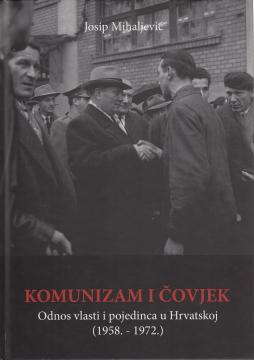
Komunizam i čovjek: Odnos vlasti i pojedinca u Hrvatskoj (1958.–1972.)

Komunizam i čovjek: Odnos vlasti i pojedinca u Hrvatskoj (1958.–1972.)

Josip Mihaljević

Josip Mihaljević's book analyzes the relationship between the government and the individual in communist Croatia (1958–1972), through repressive mechanisms, ideological pressures, and restrictions on personal freedom in the socialist system.

In his book Communism and Man. The Relationship between the Government and the Individual in Croatia (1958–1972), historian Josip Mihaljević analyzes how the communist regime shaped relations between the state and citizens during the period of stabilization and crisis of Yugoslav socialism. He focuses on everyday life in Croatia, where the political, social, and cultural spheres were under the strong control of the Party. Through archival materials, minutes of political bodies, court cases, and personal testimonies, he shows how the system sought to form a “new man” loyal to ideology and the collective.

Mihaljević sheds light on the processes by which the regime and security services restricted freedom of thought and expression – from censorship and surveillance to repression of intellectuals, students, and believers. He pays special attention to the period of the Croatian Spring, when space was opened for social and national debates, but also shows how the government once again reacted with force and purges.

The author does not present communism only as a political system, but as a form of social order that deeply affects morality, identity, and interpersonal relationships. The book combines scientific precision with a humanistic approach, revealing what happens to a person under the pressure of an ideology that seeks to reshape their consciousness and freedom.

Dimensions
25 x 16 cm
Pages
595
Publisher
Hrvatski institut za povijest, Zagreb, 2016.
 
Latin alphabet. Hardcover.
Language: Croatian.

One copy is available

Condition:Unused
 

Are you interested in another book? You can search the offer using our search engine or browse books by category.

You may also be interested in these titles

Glavaš – kronika jedne destrukcije

Glavaš – kronika jedne destrukcije

Drago Hedl

In Glavaš – Chronicle of a Destruction, Drago Hedl reveals the rise and fall of Branimir Glavaš, through a story of power, crime, and moral decline in post-war Slavonia. The documentary research turns into a poignant chronicle of our society.

Novi Liber, 2010.
Croatian. Latin alphabet. Paperback.
22.46
Izabrani radovi

Izabrani radovi

Ljubo Boban

Selected Works of Academician Ljubo Boban (2022) brings together key texts on contemporary Croatian history of the 20th century. The foreword by Damir Agičić highlights Boban's methodological rigor and objectivity in researching sensitive topics.

Srednja Europa, 2022.
Croatian. Latin alphabet. Hardcover.
24.52
Od Pola do Malnara: Putnici i istraživači u hrvatskoj kulturi od 13. do 20. stoljeća

Od Pola do Malnara: Putnici i istraživači u hrvatskoj kulturi od 13. do 20. stoljeća

Juraj Bubalo

The book by Zagreb travel writer and professor Juraj Bubalo is a kind of encyclopedia of Croatian travelers and explorers. Unique in Croatian non-fiction, it popularizes the culture of exploration and reminds us that Croats have been part of global discov

Meridijani, 2024.
Croatian. Latin alphabet. Hardcover.
28.32
Balada o Nikoli Gorjanskom

Balada o Nikoli Gorjanskom

Vlado Nemet
Tilia, 1994.
Croatian. Latin alphabet. Hardcover.
2.98
Drinovci na dlanu ruke Njegove: Monografija naselja i župe

Drinovci na dlanu ruke Njegove: Monografija naselja i župe

The monograph "Drinovci in the Palm of His Hand" is the result of years of work by 23 authors and co-authors, mostly from Drinovci. This wonderful work represents the most comprehensive and beautiful publication about a Herzegovinian village and parish to

Crkva na kamenu, 2022.
Croatian. Latin alphabet. Hardcover.
76.24
Radni logor Valpovo 1945.-1946.: dokumenti

Radni logor Valpovo 1945.-1946.: dokumenti

Vladimir Geiger

The Valpovo labor camp (1945–1946) was the largest camp for Volksdeutschers in Croatia after World War II. About 4,000 Germans and Austrians were interned; at least 1,074 died, mostly from hunger, disease, and exhausting labor.

Njemačka zajednica podunavskih Švaba u Hrvatskoj, 1999.
Croatian. Latin alphabet. Hardcover.
27.34