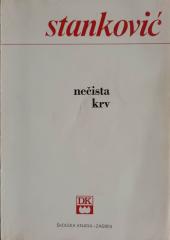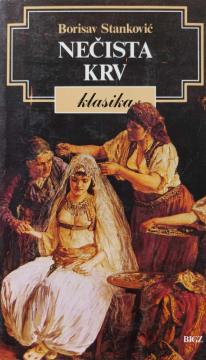
Nečista krv

Nečista krv

Borisav Stanković

"Impure Blood" (1910), Borisav Stanković's masterpiece, is a psychological novel that explores the themes of tradition, passion, social norms and the tragic fate of the individual in the patriarchal society of southern Serbia.

Set in Vranje at the end of the 19th century, the novel follows the fate of Sofka, a young girl from a wealthy čaršija family, whose life is determined by family and social pressures.

Sofka, the daughter of the wealthy Hadži-Trifun, was raised in luxury, but also by the strict rules of čaršija morality. Beautiful and sensitive, she is a symbol of a luxurious but oppressive world. Her father, faced with financial problems, decides to marry her to Tomča, the son of the poor but once respectable Marko. The marriage is arranged for convenience, and Sofka, although unhappy, accepts her fate submissive to tradition. Tomča, rude and uneducated, despises Sofka because of her "impure blood" - an allusion to her origins and social prejudices.

The novel follows Sofka's internal conflict: her sensuality and desire for love clash with patriarchal expectations. Marriage to Tomča becomes a physical and emotional burden, and Sofka sinks into despair, aware that there is no way out of the shackles of tradition. Stanković masterfully portrays her struggle with guilt, passion, and loss of identity. Characters like Marko and Hadži-Trifun reflect the complexity of the čaršija mentality, where honor and wealth dominate human emotions.

Dimensions
18 x 10.5 cm
Pages
216
Publisher
BIGZ, Beograd, 1987.
 
Distribution: 20,000 copies
 
Latin alphabet. Paperback.
Language: Serbian.
ISBN
8-61-300071-1

Multiple copies are available

Copy number 1

Condition:Used, very good condition
Damages or inconvenience notice:
  • Library stamp
  • Traces of patina

Copy number 2

Condition:Used, excellent condition

Copy number 3

Condition:Used, excellent condition
 

Are you interested in another book? You can search the offer using our search engine or browse books by category.

You may also be interested in these titles

Nečista krv

Nečista krv

Borisav Stanković
Školska knjiga, 1989.
Croatian. Latin alphabet. Hardcover.
4.993.74 - 4.99
Nečista krv

Nečista krv

Borisav Stanković
Veselin Masleša, 1987.
Croatian. Latin alphabet. Hardcover.
2.99
Nečista krv

Nečista krv

Borisav Stanković

In Vranje at the end of the 19th century, Sofka, a beautiful girl from a respectable but ruined family, carries the "impure blood" of gypsy origin. Her beauty and passion attract men, but fate is merciless: a marriage of convenience, violence, madness and

Školska knjiga, 1974.
Croatian. Latin alphabet. Paperback.
2.49 - 2.74
Deobe

Deobe

Dobrica Ćosić

Deobe is a novel about the tragic division of Serbs into Chetniks and Partisans during World War II. Winner of the NIN Award, it is part of a wider epic trilogy, inspired by Ćosić's experiences and historical documents.

Prosveta, 1963.
Croatian. Latin alphabet. Hardcover with dust jacket.
13.74
Proces

Proces

Franz Kafka

Kafka wrote The Process between 1914 and 1915, published posthumously in 1925. The novel is unfinished but with an added final chapter by Max Brod. Edition with a foreword by B. Živojinović and an afterword by Walter Killi.

BIGZ, 1990.
Serbian. Latin alphabet. Paperback.
4.26
Usta puna zemlje

Usta puna zemlje

Branimir Šćepanović

The novel "Usta puna zemlje" (1970), the masterpiece of the Serbian writer Branimir Šćepanović, is a psychologically in-depth explorer of the limits of the human soul, solitude and existential freedom, reminiscent of Kafka and Camus.

BIGZ, 1987.
Serbian. Latin alphabet. Paperback.
3.96 - 3.98