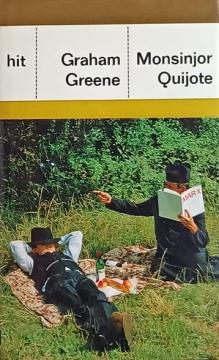
Monsinjor Quijote

Monsinjor Quijote

Graham Greene

Monsignor Quixote by Graham Greene is a humorous and philosophical novel about a village priest and a former communist mayor who travel through Spain discussing religion, politics, and the meaning of life.

Monsignor Quixote is one of the most famous later novels by British writer Graham Greene. The work is a kind of modern variation of Cervantes' novel Don Quixote. The main character is a humble village priest Father Quixote, who believes that he is a distant descendant of the famous knight from Cervantes' work. After a misunderstanding in the church hierarchy, he unexpectedly receives the title monsignor, which causes envy and ridicule in his environment.

His closest friend is the former communist mayor Sancha, whom everyone calls Sancho, an obvious allusion to Sancho Panza. When both of them become unwanted in their environment, they set off on a journey in an old Seat car, which Quixote calls Rocinante, after the horse of Cervantes' hero.

During their journey through Spanish villages and cities, they meet different people and constantly discuss religion, communism, civil war, love, death and human nature. Monsignor Quixote defends the Christian faith, while Sancho advocates Marxist ideas, but their discussions are not hostile. On the contrary, they are based on mutual respect and sincere friendship.

As the plot progresses, political and religious themes gradually give way to universal questions about goodness, forgiveness, and the meaning of human life. Particularly important are the moments in which both realize that, despite their ideological differences, they are connected by the same human needs and moral dilemmas.

The novel combines humor, adventure, and philosophical debate. Through the characters of Quixote and Sancho, Greene explores the possibility of dialogue between opposing worldviews and shows that friendship and understanding can overcome political and religious divisions. For this reason, Monsignor Quixote is considered one of his warmest and most humane novels.

Original title
Monsignor Quixote
Translation
Ljerka Radović
Editor
Zlatko Crnković
Illustrations
Dražen Pomykalo
Graphics design
Alfred Pal
Dimensions
20 x 12 cm
Pages
245
Publisher
Znanje, Zagreb, 1983.
 
Latin alphabet. Hardcover with dust jacket.
Language: Croatian.

Two copies are available

Copy number 1

Condition:Unused

Copy number 2

Condition:Used, excellent condition
 

Are you interested in another book? You can search the offer using our search engine or browse books by category.

You may also be interested in these titles

Ministarstvo straha

Ministarstvo straha

Graham Greene
Kosmos, 1960.
Serbian. Latin alphabet. Paperback.
2.99
Mirni Amerikanac

Mirni Amerikanac

Graham Greene

The Quiet American (1955) is set in Vietnam in the 1950s, during the French colonial struggle against the insurgents. Through the atmosphere of Saigon, Greene creates a tense story of love and political intrigue, with a strong critique of the Vietnam War

Jutarnji list, 2004.
Croatian. Latin alphabet. Hardcover with dust jacket.
2.42 - 4.99
Srž stvari

Srž stvari

Graham Greene
Kršćanska sadašnjost, 1979.
Croatian. Latin alphabet. Hardcover.
5.32
Plavi bicikl

Plavi bicikl

Regine Deforges

The Blue Bicycle by Régine Deforges is a historical romance novel set in France during World War II. The main character, Léa Delmas, goes through the horrors of war, romantic conflicts, and personal maturation.

Znanje, 1987.
Croatian. Latin alphabet. Hardcover with dust jacket.
3.36 - 3.42
Eva Luna

Eva Luna

Isabel Allende

Eva Luna is a novel about a poor storyteller who weaves lives with words, written by Isabel Allende, the founder of Latin American magical realism. Published after the success of The House of the Spirits, this whirlwind of adventure combines love, revolut

Znanje, 1990.
Croatian. Latin alphabet. Hardcover with dust jacket.
8.36
Konačna dijagnoza

Konačna dijagnoza

Arthur Hailey

Arthur Hailey's Final Diagnosis is a medical novel set in a large hospital. Through the fates of doctors and patients, it depicts responsibility, professional errors, and the conflict between tradition and progress in medicine.

Znanje, 1972.
Croatian. Latin alphabet. Hardcover with dust jacket.
4.42