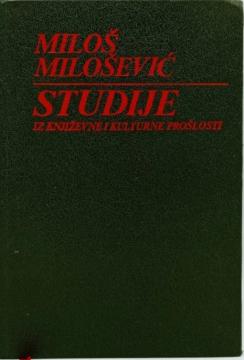
Studije iz književne i kulturne prošlosti

Studije iz književne i kulturne prošlosti

Miloš Milošević
Graphics design
Božidar Pavićević-Zodijak
Dimensions
21 x 15 cm
Pages
518
Publisher
NIO Univerzitetska riječ, Podgorica, 1987.
 
Latin alphabet. Paperback.
Language: Croatian.

No copies available

The last copy was sold recently.
 

Are you interested in another book? You can search the offer using our search engine or browse books by category.

You may also be interested in these titles

Pedeset nijansi slobodniji

Pedeset nijansi slobodniji

E. L. James
Profil Knjiga, 2012.
Croatian. Latin alphabet. Paperback.
5.35
Dnevnik 1: Dnevnik 1914 - 17 (Davni dani I)

Dnevnik 1: Dnevnik 1914 - 17 (Davni dani I)

Miroslav Krleža

The 1914–17 diary records Krleža's writings from the First World War: personal dilemmas, pacifism, conflict with the militarism of the Monarchy, and intellectual maturation in the years of the collapse of the old world.

NIŠRO Oslobođenje, 1981.
Croatian. Latin alphabet. Hardcover.
6.78
Iranska veza

Iranska veza

William H. Hallahan
August Cesarec, 1990.
Croatian. Latin alphabet. Hardcover with dust jacket.
7.92
Krvna veza

Krvna veza

Sidney Sheldon

Sidney Sheldon's The Bloodline (1977) is a suspenseful thriller that explores the power, greed, and secrets within a wealthy family that controls a global pharmaceutical empire. Set in a high-stakes world, the novel combines drama, intrigue, and family co

Otokar Keršovani, 1983.
Croatian. Latin alphabet. Hardcover with dust jacket.
4.36 - 5.32
Put u Jajce

Put u Jajce

Edvard Kocbek

In Put u Jajce, Edvard Kocbek provides personal and political testimony about key moments in Yugoslav history. The book is based on Kocbek's memories from the Second World War, especially the trip to Jajce in 1943.

Znanje, 1978.
Croatian. Latin alphabet. Hardcover with dust jacket.
8.386.70
Kako stoje stvari: Predavanje održano u Domu JNA u Zagrebu 17. 12. 1952.

Kako stoje stvari: Predavanje održano u Domu JNA u Zagrebu 17. 12. 1952.

Miroslav Krleža

In his lecture How Things Are (1952), Krleža discusses the political and cultural situation of post-war Yugoslavia, emphasizing the need for critical thought, cultural renewal, and resistance to dogmatism.

Zora, 1953.
Croatian. Latin alphabet. Paperback.
12.48