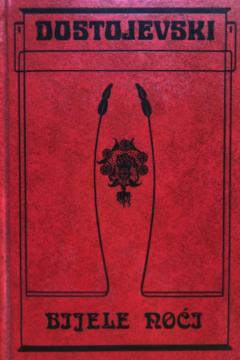
Bijele noći / Netočka Nezvanova / Mali junak / Selo Stepančikovo

Bijele noći / Netočka Nezvanova / Mali junak / Selo Stepančikovo

Fjodor Mihajlovič Dostojevski

The works collected in this volume reflect Dostoevsky's early phase, with a focus on psychological depth, social criticism, and complex emotions, foreshadowing the themes that would dominate his later masterpieces.

  • White Nights (1848) is a romantic novella about a lonely dreamer in St. Petersburg who, during the "white nights", meets Nastenka, a girl waiting for her lover. Their nightly conversations give rise to a tender connection, but the dreamer's love remains unrequited as Nastenka returns to her fiancé. The work explores themes of loneliness, unrequited love and longing, with a poetic depiction of the atmosphere of St. Petersburg.

  • Netochka Nezvanova (1849) is an unfinished novel about a girl Netochka, an orphan who grew up in poverty. The story follows her childhood, her relationship with her stepfather, a violinist obsessed with art, and later life in a wealthy family where she deals with jealousy and complex relationships. The novel explores trauma, art and the fate of women, but remains fragmentary because Dostoevsky interrupted work on it after his arrest.

  • The Little Hero (1849) is a novella written during Dostoevsky's imprisonment in the Peter and Paul Fortress. It tells the story of an eleven-year-old boy who experiences his first love for an adult woman during a summer vacation in the countryside. Through the boy's perspective, Dostoevsky subtly depicts the awakening of feelings, innocence, and complexity of emotional maturation, with hints of the social conventions that constrain them.

Translation
Iso Velikanović
Editor
Jakša Kušan
Graphics design
Boris Dogan
Dimensions
21 x 14 cm
Pages
435
Publisher
Znanje, Zagreb, 1982.
 
Latin alphabet. Hardcover.
Language: Croatian.

One copy is available

Condition:Unused
 

Are you interested in another book? You can search the offer using our search engine or browse books by category.

You may also be interested in these titles

Braća Karamazovi

Braća Karamazovi

Fjodor M. Dostojevski

The Brothers Karamazov is the last novel of the Russian genius Fyodor Mikhailovich Dostoyevsky, which he completed less than three months before his death.

Globus, 2004.
Croatian. Latin alphabet. Hardcover.
12.34 - 12.38
Zločin i kazna

Zločin i kazna

Fjodor Mihajlovič Dostojevski

Crime and Punishment is a novel by Russian writer Fyodor Mikhailovich Dostoevsky, published in 1866 in the journal Russian Herald. It is considered one of the greatest works of Russian literature. The plot is set in Saint Petersburg in the mid-1860s.

Rad, 1988.
Serbian. Latin alphabet. Hardcover.
7.605.70
Ujakov san / Poniženi i uvrijeđeni

Ujakov san / Poniženi i uvrijeđeni

Fjodor Mihajlovič Dostojevski

Both works reflect Dostoevsky's early phase, with a focus on social criticism, psychological analysis and moral dilemmas, foreshadowing the themes of his later masterpieces.

Znanje, 1982.
Croatian. Latin alphabet. Hardcover.
11.4610.61 - 13.2611.48
Džingis-kan

Džingis-kan

Vasilij Jan

Vasily Yan's novel Genghis Khan depicts the rise of the Mongol leader Temujin, from childhood in the steppes to the creation of the largest empire in the world, highlighting his courage, cruelty, and relentless will to power.

Rad, 1988.
Serbian. Latin alphabet. Hardcover.
9.78
Djetinjstvo

Djetinjstvo

Lav Nikolajevič Tolstoj

Childhood (1852) is the first book of an autobiographical trilogy (with Adolescence and Youth), where Tolstoy explores the world of childhood through the eyes of a ten-year-old boy, Nikolinka Irtenjev – innocence, joys, sorrows and first traumas.

Svjetlost, 1971.
Croatian. Latin alphabet. Hardcover.
6.54
Djela #9: Ispovest / Život suvišna čoveka

Djela #9: Ispovest / Život suvišna čoveka

Maksim Gorki
Kultura, 1950.
Serbian. Cyrillic alphabet. Hardcover.
3.86