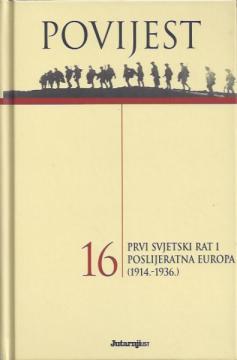
Povijest #16: Prvi svjetski rat i poslijeratna Europa (1914.-1936.)

Povijest #16: Prvi svjetski rat i poslijeratna Europa (1914.-1936.)

The sixteenth volume covers the period from 1914 to 1936, marked by the First World War and its aftermath. The book is richly illustrated, providing a comprehensive account of the war, its aftermath, and the causes leading up to the Second World War.

The war (1914–1918), sparked by the assassination of Franz Ferdinand, involved global powers in trench warfare, with enormous casualties. The alliances (the Entente and the Central Powers) fought until the Entente won, and the Treaty of Versailles (1919) imposed harsh terms on Germany, fueling future tensions.

Postwar Europe faced political and economic instability. New states emerged (Yugoslavia, Czechoslovakia), while empires collapsed (Austro-Hungary, Ottoman). The Russian Revolution (1917) led to the establishment of Bolshevik rule and the USSR. The economic crisis of 1929 worsened conditions, fueling unemployment and political extremism. Fascism in Italy (Mussolini) and Nazism in Germany (Hitler) grew stronger, while the Spanish Civil War (1936) heralded new conflicts.

Culturally, the period brought modernism in art (Picasso, Kafka) and scientific progress (Einstein). In the Croatian context, the creation of the Kingdom of Serbs, Croats, Croats and Slovenes (1918), later Yugoslavia, and the tension between centralization and Croatian aspirations for autonomy are highlighted.

Original title
Il Novecento: La Prima Guerra Mondiale e l’Europa del Dopoguerra
Translation
Ana Badurina
Editor
Ivo Goldstein
Dimensions
22 x 15 cm
Pages
599
Publisher
Europapress holding, Zagreb, 2008.
 
Latin alphabet. Hardcover.
Language: Croatian.
ISBN
978-9-53300-053-4

One copy is available

Condition:Unused
 

Are you interested in another book? You can search the offer using our search engine or browse books by category.

You may also be interested in these titles

Ljudi-miševi

Ljudi-miševi

Manuel Leguineche, Jesus Torbado

The book "Mice People" by Manuel Leguineche and Jesús Torbad is an extremely powerful testimony about human destinies during and after the Spanish Civil War (1936-1939).

Alfa, 1979.
Croatian. Latin alphabet. Hardcover with dust jacket.
6.32
Dizanje prošlosti u vazduh: Ogledi o Balkanu i Istočnoj Evropi

Dizanje prošlosti u vazduh: Ogledi o Balkanu i Istočnoj Evropi

Marija Todorova

A collection of essays by the Bulgarian historian Maria Todorova (known for Imaginary Balkans), compiled especially for the 20th Century Library. Indispensable for understanding post-communist transitions, culture of memory and Balkan studies.

Biblioteka XX vek, 2010.
Serbian. Latin alphabet. Paperback.
8.445.91
Turska noć

Turska noć

Philippe Videlier

The crime against the Armenians is only coming to light today. After almost a century, the tragedy of a nation, the indifference of the Constantinople authorities, the media cover-up and the turning of the international community's head are unfolding befo

Durieux, 2010.
Croatian. Latin alphabet. Hardcover with dust jacket.
11.42
Nevidljivi neprijatelj na Atlantiku 1-2

Nevidljivi neprijatelj na Atlantiku 1-2

Boris Prikril

The book provides a detailed account of naval conflicts in the Atlantic Ocean during World War II, with particular emphasis on the Battle of the Atlantic Convoy and the activities of German submarines – the so-called "invisible enemy".

Znanje, 1985.
Croatian. Latin alphabet. Hardcover with dust jacket.
The book consists of two volumes
6.985.24
Protagonisti Drugog svjetskog rata: Adolf Hitler - Führer Trećega Reicha

Protagonisti Drugog svjetskog rata: Adolf Hitler - Führer Trećega Reicha

Joan Solé

In the book, Joan Solé shows the life, ideology and rise of Adolf Hitler. The book explores how a charismatic but fanatical leader shaped a totalitarian regime and plunged the world into one of the most tragic wars in history.

Twins Company d.o.o., 2025.
Croatian. Latin alphabet. Paperback.
8.56
O boljševizmu (1920-1921) - zabranjeni Masarik

O boljševizmu (1920-1921) - zabranjeni Masarik

Tomáš G. Masaryk

In this edition, translated by dr. Aleksandar Ilić, there are texts of the first Czechoslovak president in which he timely criticizes Marx, Engels and Lenin, and actually goes on to criticize imperialism in general.

Zavod za udžbenike i nastavna sredstva, 2014.
Serbian. Cyrillic alphabet. Paperback.
9.76