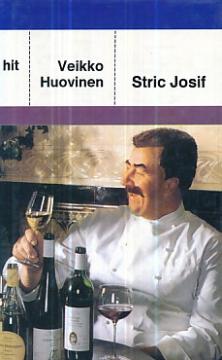
Stric Josif

Stric Josif

Veikko Huovinen

The book Uncle Joseph (1988) is a satirical collection of 15 stories about the life of Joseph Stalin, written by the Finnish writer and forestry expert (1927–2009) as "memories of a contemporary." The moral of the work is that power corrupts, and satire h

Huovinen, known for realism, pacifism and humor (as in The Year of the Rabbit), here mixes historical fact with fiction, portraying Stalin from boyhood to death - from a poor cobbler and worshiper of God to a bloodthirsty dictator.

The stories follow key episodes: childhood in Georgia, revolutionary days, the murder of his wife Nadezhda (disguised as suicide), purges and paranoia. Fictional additions such as Stalin's African hunting expedition (where he smokes pot in an ivory tusk chair) or interest in the natural sciences emphasize the absurdity of his power. One story describes the hunt for "Sekwa ​​ka khofeni hutshena" – a fictional animal, symbolizing colonial cruelty.

The satire criticizes despotism, greed and authoritarianism, comparing Stalin to modern leaders like Putin. Huovinen's humor is dark and ironic, with reverse empathy – the reader laughs, but is also horrified by the brutality. Language masterfully with today's politically incorrect attitudes and expressions, reflecting the 1980s. The book, like Veitikka about Hitler, enriches Huovinen's cycle about "mahtimiesten".

Original title
Joe-setä: Aikalaisen kertomuksia Josef Stalinista
Translation
Siiri Alakorva, Dragutin Balagović
Editor
Zlatko Crnković
Graphics design
Alfred Pal
Dimensions
20 x 12 cm
Pages
161
Publisher
Znanje, Zagreb, 1992.
 
Latin alphabet. Hardcover with dust jacket.
Language: Croatian.
ISBN
8-63-130242-2

Two copies are available

Copy number 1

Condition:Used, excellent condition

Copy number 2

Condition:Used, very good condition
Discounted price: 7.124.98
30% discount is valid until 7/15/26 11:59 pm
 

Are you interested in another book? You can search the offer using our search engine or browse books by category.

You may also be interested in these titles

Krasopis

Krasopis

Pavao Pavličić

What happens when the writer himself is the protagonist of his novel and writes it in the first person? The answer to this question can be obtained by reading the novel "Krasopis".

Znanje, 1987.
Croatian. Latin alphabet. Hardcover with dust jacket.
4.36 - 4.42
Ragtime

Ragtime

E. L. Doctorow

The novel Ragtime (1975) is one of E. L. Doctorow's most famous works, which masterfully interweaves fiction and real historical events. Ragtime is a powerful picture of American society, a novel that sheds light on true historical processes through ficti

Znanje, 1981.
Croatian. Latin alphabet. Hardcover with dust jacket.
4.74 - 4.76
Amandino vjenčanje

Amandino vjenčanje

Jenny Colgan

A romantic comedy about friendship, love, and the chaotic attempts to save a good man from a bad marriage. A chick-lit hit, it reminds us that friendship saves more than any plan, and love comes unexpectedly.

Znanje, 2001.
Croatian. Latin alphabet. Paperback.
5.36
Čovjek sa bezbroj imena

Čovjek sa bezbroj imena

Graham Greene

Young Victor Baxter grows up under the guardianship of the mysterious Captain and the woman who gives him a new name – Jim. His search for the truth about their identities leads him to discoveries about love, betrayal and his own life.

Znanje, 1989.
Croatian. Latin alphabet. Hardcover with dust jacket.
4.76 - 5.36
Večernji akt

Večernji akt

Pavao Pavličić

The story, centered on the brilliant forger Mihovil, criticizes the literature and art of our time. It also reflects on a society that is ready to adapt the coordinates of history to its own needs.

Znanje, 1981.
Croatian. Latin alphabet. Hardcover with dust jacket.
3.98
Put u Jajce

Put u Jajce

Edvard Kocbek

In Put u Jajce, Edvard Kocbek provides personal and political testimony about key moments in Yugoslav history. The book is based on Kocbek's memories from the Second World War, especially the trip to Jajce in 1943.

Znanje, 1978.
Croatian. Latin alphabet. Hardcover with dust jacket.
8.38