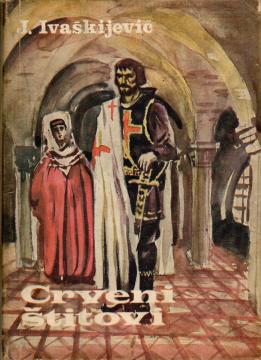
Crveni štitovi

Crveni štitovi

Jaroslaw Iwaszkiewicz

"Red Shields" is a historical novel that narrates the dramatic events of Poland's medieval past. One of the key works of Polish literature, recognizable by its lyrical language and deep reflection on historical milestones.

The plot is set in the 13th century and follows the life of the Polish prince Henryk Pobożny, who faces the Mongol invasion and the fateful battle of Legnica in 1241.

The novel skilfully combines historical fact and literary fiction, creating a deep psychological study of character and time. Prince Henrik, portrayed as a brave and dedicated leader, faces inner dilemmas and fears as he tries to protect his people and preserve Christian values ​​in a time of great trials.

Through lavish descriptions and the atmosphere of medieval Europe, Ivashkievich depicts the clash of civilizations — between Christian Europe and the pagan Mongols. The novel raises questions about faith, responsibility, and moral choices as Prince Henrik strives to defend his homeland in the face of an overwhelming military threat.

The title "Red Shields" symbolizes the bloody struggle and heroism of Polish warriors, but also the heavy burden of the ruler's duty. Through complex characters and striking scenes of battles, Ivashkievich builds a powerful epic story of sacrifice and tragedy, while at the same time analyzing human destiny in the face of imminent defeat.

Original title
Czerwone tarcze
Translation
Petar Vujičić
Editor
Gojko Janjušević
Graphics design
Mirko Stojnić
Dimensions
17 x 12.5 cm
 
The book consists of two volumes.
Pages total
265
Publisher
Progres, Novi Sad, 1965.
 
Latin alphabet. Hardcover.
Language: Serbian.

No copies available

The last copy was sold recently.
 

Are you interested in another book? You can search the offer using our search engine or browse books by category.

You may also be interested in these titles

Devojka i golubovi, Mlin na kamjoni

Devojka i golubovi, Mlin na kamjoni

Jaroslaw Iwaszkiewicz
Rad, 1964.
Serbian. Latin alphabet. Paperback.
0.99
Chopin

Chopin

Jaroslaw Iwaszkiewicz
Nakladni zavod Hrvatske, 1949.
Croatian. Latin alphabet. Paperback.
1.00 - 2.00
Devojka i golubovi

Devojka i golubovi

Jaroslaw Iwaszkiewicz

Young Edek lives with his elderly father who tries to keep his son by his side. The boy's longing for freedom and a girl clashes with his father's possessiveness. The pigeons symbolize unattainable freedom. The conflict leads to a tragic ending.

Svjetlost, 1965.
Serbian. Latin alphabet. Paperback.
2.14
Svjetska knjižnica, Sv. 3.

Svjetska knjižnica, Sv. 3.

Fjodor M. Dostojevski, Henryk Sienkiewicz

The World Library, Volume 3, edited and published by Iso Velikanović, contains excerpts from The Brothers Karamazov by F. M. Dostoevsky and Without Dogma by H. Sienkiewicz. Designed for self-binding of individual works.

Vlastita naklada, 1903.
Croatian. Latin alphabet. Paperback.
17.24
Seljaci IV: Ljeto

Seljaci IV: Ljeto

Władysław Stanisław Reymont

Peasants IV: Summer is the final and most powerful part of the epic tetralogy Peasants. The culmination of the conflict in the village of Lipce during the hot summer and harvest, the drama surrounding Jagna, the death of Maciej Boryna and the final closin

Matica hrvatska, 1935.
Croatian. Latin alphabet. Hardcover.
7.26 - 23.54 (set)
Granica

Granica

Zofia Nałkowska

Through the fate of the ambitious Zenon Ziembiewicz, the novel Granica depicts the transgression of moral, social and human boundaries – careerism, class differences and the price of compromise in interwar Polish society.

Minerva, 1956.
Serbian. Latin alphabet. Hardcover.
5.42