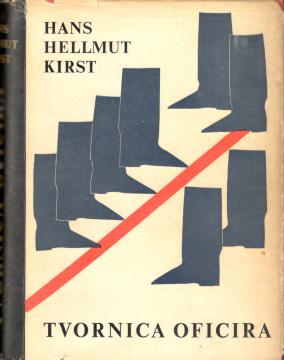
Tvornica oficira

Tvornica oficira

Hans Hellmut Kirst

The novel follows the investigation into the alleged suicide of cadet Walter Dornberger at a German military school during World War II and exposes the corruption, fear, and moral decline of the military system.

The novel Officer's Factory by Hans Hellmut Kirst is set during World War II, in a German military school where future Wehrmacht officers are trained. The novel begins with the death of a young cadet Walter Dornberger, which is ruled a suicide. However, the circumstances of his death raise suspicions, so an investigation is launched led by Captain Robert Ritter.

During the investigation, Ritter gradually uncovers hidden relationships between the cadets and their superiors. The military school, which is supposed to produce officers of honor and responsibility, is presented as a system dominated by obedience, ambition, fear, and the struggle for position. Many officers try to protect their own interests and the reputation of the army, even when this means concealing the truth.

Through the characters, Kirst depicts different attitudes towards the Nazi regime and the war – from blind obedient servants to people who begin to doubt the meaning of the ideology they serve. He particularly emphasizes how the military hierarchy can turn an individual into an executor of orders without their own moral judgment.

The novel is not just a crime story about a single death, but a powerful critique of militarism, authoritarian upbringing, and a system that produces officers who are ready to follow orders without question. The main message of the work is that the greatest danger does not come only from wars, but also from people who renounce personal responsibility in the name of obedience and ideology.

Original title
Fabrik der offiziere
Translation
Ljerka Linić-Šeferov
Dimensions
19.5 x 15.5 cm
Pages
576
Publisher
Naprijed, Zagreb, 1965.
 
Latin alphabet. Hardcover with dust jacket.
Language: Croatian.

One copy is available

Condition:Used, excellent condition
Damages or inconvenience notice:
  • Slight damage to the dust jacket
 

Are you interested in another book? You can search the offer using our search engine or browse books by category.

You may also be interested in these titles

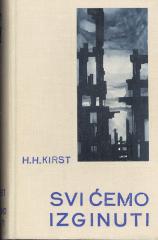
Svi ćemo izginuti

Svi ćemo izginuti

Hans Hellmut Kirst

We Shall All Perish (1957) is a cataclysmic novel by Hans Hellmut Kirst, a famous German writer who became famous for his war trilogy “08/15.” It is a realistic, documentary-style depiction of the outbreak of World War III and a nuclear holocaust.

Otokar Keršovani, 1961.
Croatian. Latin alphabet. Paperback.
6.324.42
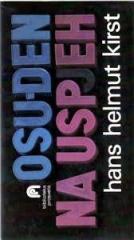
Osuđen na uspjeh

Osuđen na uspjeh

Hans Hellmut Kirst

In this work, the character of police inspector Keller appears for the first time, who fights crime with unusual methods.

Prosveta, 1987.
Croatian. Latin alphabet. Paperback.
4.983.74
I ne reče ni reči

I ne reče ni reči

Heinrich Böll

In Boll's novels, one of the central themes is the attempt to preserve basic moral values ​​in a time of terror, as well as in a period of material prosperity and corruption.

Svjetlost, 1965.
Serbian. Latin alphabet. Paperback.
3.22 - 3.98
Vergilijeva smrt

Vergilijeva smrt

Hermann Broch

The Death of Virgil (1945) is Hermann Broch's most famous work. The novel follows the final days of the Roman poet Publius Virgilius Marus, who, gravely ill, travels from Athens to Brundisium, arriving on the birthday of Emperor Augustus in 19 AD.

Svjetlost, 1982.
Croatian. Latin alphabet. Hardcover.
6.995.24
Razbojnici

Razbojnici

Friedrich Schiller

"The Robbers" (1781), Friedrich Schiller's first play, is a key work of the German Sturm und Drang movement, which explores themes of freedom, justice, moral conflict, and rebellion against social norms.

August Cesarec, 1987.
Croatian. Latin alphabet. Paperback.
3.36 - 3.48