Vladavina Hrvatsko-srpske koalicije : 1906-1907
Rare book

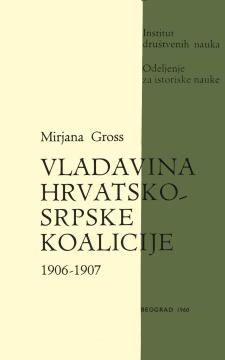
Vladavina Hrvatsko-srpske koalicije : 1906-1907

Mirjana Gross

Mirjana Gross' monograph on the politics and rule of the Croatian-Serbian coalition 1906–1907. Analysis of the formation, activities, conflicts and fall of the coalition within the framework of Austro-Hungarian relations.

The Reign of the Croatian-Serbian Coalition 1906–1907 is the first major monograph by the distinguished Croatian historian Mirjana Gross (1922–2012). The book represents her habilitation work. The work deals in detail with the period of rule of the Croatian-Serbian Coalition (HSK), which was founded on the foundations of the policy of the “New Course” and the Rijeka Resolution (1905). The coalition took power in Croatia after winning the elections in 1906, and was led by Franjo Supilo, Svetozar Pribićević and other leaders of the Croatian and Serbian liberal and progressive movements. Gross analyzes three main units: the formation of the coalition, its internal policy, and relations with Hungary and Vienna.

The author shows how the coalition tried to implement constitutional and administrative reforms, expand Croatian autonomy, resolve the Dalmatian issue and modernize the country, but encountered strong resistance from Hungarian ruling circles, Greater Austrian factors and the domestic opposition (especially Joseph Frank and the Rightists). The conflict over railway pragmatics in 1907, obstruction in the Budapest parliament and the final fall of the coalition government are particularly addressed. Gross shows the limitations of the "new course" policy in the dualistic system of Austria-Hungary, where the coalition had to balance between Croatian national interests, the Yugoslav idea and pragmatic compromises with the Hungarians.

The book is written in the spirit of the Yugoslav historiography of the time, but it stands out for its thoroughness of archival research and relative objectivity. It is considered a classic and the most important work on this topic in Croatian historiography of the 20th century. It is still used today as basic literature for the study of Croatian politics during the period of dualism, national relations between Croats and Serbs, and the crisis of the Austro-Hungarian system on the eve of World War I.

Dimensions
27 x 17 cm
Pages
248
Publisher
Institut društvenih nauka, Beograd, 1960.
 
Latin alphabet. Paperback with dust jacket.
Language: Croatian.

One copy is available

Condition:Used, good condition (visible signs of use)
Damages or inconvenience notice:
  • Slight damage to the cover
  • Library stamp
 

Are you interested in another book? You can search the offer using our search engine or browse books by category.

You may also be interested in these titles

Proizvodnja pokljuka u Požeškom Novom Selu: Separat

Proizvodnja pokljuka u Požeškom Novom Selu: Separat

Zdenka Lechner

Zdenka Lechner, the first ethnologist at the Museum of Slavonia (1951–1965), made significant contributions to the study of the traditional culture of Slavonia, including the use of pokljuc – earthen lids for baking bread and pastries on the hearth.

Muzej Slavonije, 1962.
Croatian. Latin alphabet. Paperback.
6.32
Povijest i kultura Hrvata kroz 1000 godina: Od velikih seoba do XVIII. stoljeća

Povijest i kultura Hrvata kroz 1000 godina: Od velikih seoba do XVIII. stoljeća

Horvat
Josip Horvat

One of the most prominent Croatian cultural historians, Josip Horvat, in one of his best texts, not only describes the cultural achievements of Croats, but also analyzes them on the basis of political, social and other events that Croatian history is full

Knjigotisak d. o. o., 2009.
Croatian. Latin alphabet. Hardcover.
12.20
Povijest i kultura Hrvata kroz 1000 godina: gospodarski i društveni razvitak u 18. i 19. stoljeću

Povijest i kultura Hrvata kroz 1000 godina: gospodarski i društveni razvitak u 18. i 19. stoljeću

Horvat
Josip Horvat

This part of Horvat's work depicts the great changes that affected Croatian lands during the 18th and 19th centuries, a period of transition from feudal to modern society.

Knjigotisak d. o. o., 2009.
Croatian. Latin alphabet. Hardcover.
12.22
1848

1848

Horvat
Josip Horvat

The book One Thousand Eight Hundred and Eight (first edition 1934, second 1973) by Josip Horvat is a detailed account of the revolutionary year 1848 in Croatia, a key moment in the shaping of national identity and political consciousness.

Nakladni zavod Matice hrvatske, 1973.
Croatian. Latin alphabet. Hardcover with dust jacket.
The book consists of two volumes
14.56
Eseji i članci

Eseji i članci

Ljubo Karaman

The collection Essays and Articles by Ljubo Karaman, an eminent art historian, includes a series of texts on Croatian art, with an emphasis on the medieval heritage of Dalmatia and its connection with European cultural movements.

Matica hrvatska, 1939.
Croatian. Latin alphabet. Hardcover.
6.48 - 10.349.56
Zaraćeno poraće: Konfliktni i konkurentski narativi o stradanju i iseljavanju Talijana Istre

Zaraćeno poraće: Konfliktni i konkurentski narativi o stradanju i iseljavanju Talijana Istre

Franko Dota

The book analyzes how conflicting historical narratives about the suffering and mass emigration of Italians from Istria and Rijeka developed in Croatia and Italy after World War II (1943–1956), debunking myths and encouraging an empathetic approach to the

Srednja Europa, 2010.
Croatian. Latin alphabet. Paperback.
11.32