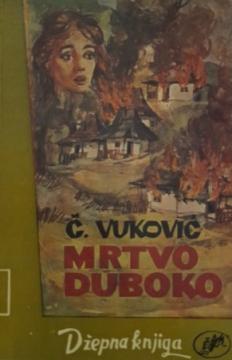
Mrtvo duboko

Mrtvo duboko

Čedo Vuković

An innovatively told story about the hiding of partisans from the Chetniks in the isolated Montenegrin village of Mrtvo Duboko during World War II.

Editor
Risto Trifković
Graphics design
Safet Zec
Dimensions
17 x 11 cm
Pages
163
Publisher
Svjetlost, Sarajevo, 1963.
 
Latin alphabet. Paperback.
Language: Croatian.

Two copies are available

Copy number 1

Condition:Used, excellent condition

Copy number 2

Condition:Used, excellent condition
Damages or inconvenience notice:
  • Traces of patina
 

Are you interested in another book? You can search the offer using our search engine or browse books by category.

You may also be interested in these titles

Svemoćno oko

Svemoćno oko

Čedo Vuković
Svjetlost, 1988.
Croatian. Latin alphabet. Hardcover.
3.90 - 3.98
Hrvatska borba za opstojnost 1918.-1998.

Hrvatska borba za opstojnost 1918.-1998.

Milivoj Kujundžić, Zdravko Dizdar

The book contains an account of the history of Croatia from 1918 to 1998 in four historical periods (1918-1941; 1941-1945, 1945-1990 and 1990-1998).

Hrvatski državni sabor, 2000.
Croatian. Latin alphabet. Hardcover.
6.424.81
Bormannova braća idu dalje

Bormannova braća idu dalje

William Stevenson

The book reveals the secret network through which Martin Bormann, Hitler's treasurer, ensured the survival of Nazi power and capital after the fall of the Third Reich.

NIŠRO "Vjesnik", 1977.
Croatian. Latin alphabet. Hardcover.
6.54
Zabilješke iz ratnih dana

Zabilješke iz ratnih dana

Vojislav Kecmanović Đedo
NIŠRO Oslobođenje, 1980.
Croatian. Latin alphabet. Hardcover.
5.50
Slučaj Kappler : Od Ardeatina do Soltaua

Slučaj Kappler : Od Ardeatina do Soltaua

Guido Gerosa

Who was Herbert Kappler? Chief of the Gestapo in Rome during Nazi rule in the months of terror that preceded the liberation.

Otokar Keršovani, 1978.
Croatian. Latin alphabet. Paperback.
5.48
Kroz tajni arhiv Udbe

Kroz tajni arhiv Udbe

Nikola Milovanović

The author of this book describes the fate of the main enemies of the Yugoslav communists in the last stage of the war, as well as their attempts to prevent the consolidation of communist power in Yugoslavia in the first post-war years.

Sloboda, 1986.
Croatian. Latin alphabet. Hardcover with dust jacket.
The book consists of two volumes
15.26