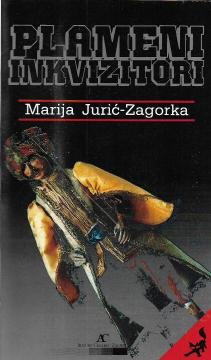
Plameni inkvizitori

Plameni inkvizitori

Marija Jurić Zagorka

In Flaming inquisitors, three different love couples are shown "each of whom will have his own audience with his own love and his own idea". The novel is based on historical sources about the reign of King Stephen VI. and his son Ladislav IV. Kumana.

The events take place in Croatia and Hungary (Grič, Buda, Požega) in the 13th century, in the time that covers the last year of Stephen's reign (1272) and the first year of the reign of the minor Ladislav and his mother Elizabeth, Stephen's widow (1273). It is about the time of the Catholic Church's fight against the "heretical" Bogomils, the conflict and reconciliation of the Hungarian kings with Rudolph of Habsburg and the Czech king Otokar, and the quarrels of the Croatian nobles Gisingovci and Babonić, that is, about the time of "lunatic superstition", "rage of hysterical bloodlust", "century madness and hysteria" in which only the "right of the stronger" reigns.

Editor
Bože Čović
Graphics design
Nenad Dogan
Dimensions
19 x 11 cm
Pages
955
Publisher
August Cesarec, Zagreb, 1986.
 
Latin alphabet. Paperback.
Language: Croatian.

No copies available

The last copy was sold recently.
 

Are you interested in another book? You can search the offer using our search engine or browse books by category.

You may also be interested in these titles

Gordana III: Pakao prijestolja

Gordana III: Pakao prijestolja

Marija Jurić Zagorka
Stvarnost, 1966.
Croatian. Latin alphabet. Hardcover.
8.52
Gordana VI: Veliki sud

Gordana VI: Veliki sud

Marija Jurić Zagorka
Stvarnost, 1966.
Croatian. Latin alphabet. Hardcover.
8.34
Vitez slavonske ravni

Vitez slavonske ravni

Marija Jurić Zagorka
August Cesarec, 1986.
Croatian. Latin alphabet. Paperback.
2.98
Vienac 3 / 1944.

Vienac 3 / 1944.

Josip Jedvaj, Agata Truhelka, Milan Begović, Ivo Ladika, Jerolim Miše, Kruno Krstić, Adam Mickiew...

The issue of Vienca from the period of the Independent State of Croatia brings literary, linguistic and artistic contributions and reflects the cultural policy, national identity and intellectual life of wartime Croatia.

Hrvatski izdavalački bibliografski zavod (HIBZ), 1944.
Croatian. Latin alphabet. Paperback.
5.00
Barun Ivica

Barun Ivica

August Šenoa

Baron Ivica depicts the disintegration of a peasant cooperative after the abolition of serfdom. Baron Ivica, a frivolous nobleman, exploits the peasants, leading to their moral and material decline. Šenoa criticizes the transitional society.

Hrvatsko književno društvo Sv. Jeronima, 1932.
Croatian. Latin alphabet. Hardcover.
6.34
Na vrhu jezika i pera (1932.-1942.)

Na vrhu jezika i pera (1932.-1942.)

Vladimir Nazor

A collection of essays, notes, and reflections in which Nazor combines literature, culture, and personal reflections, testifying to the spiritual and social turmoil of wartime.

Hrvatski izdavalački bibliografski zavod (HIBZ), 1942.
Croatian. Latin alphabet. Hardcover with dust jacket.
7.46 - 8.24