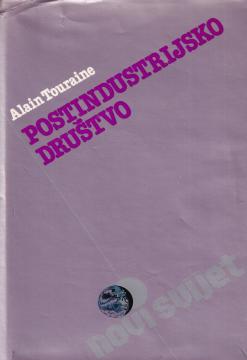
Postindustrijsko društvo

Postindustrijsko društvo

Alain Touraine
Original title
La sociIete post-industrielle
Translation
Branka Fulanović i Sanja Tamburašev
Editor
Adolf Dragičević i Ante Marušić
Dimensions
21 x 13 cm
Pages
355
Publisher
Globus, Zagreb, 1980.
 
Latin alphabet. Hardcover with dust jacket.
Language: Croatian.

One copy is available

Condition:Used, very good condition
Damages or inconvenience notice:
  • Damaged book cover
  • Yellowed pages
 

Are you interested in another book? You can search the offer using our search engine or browse books by category.

You may also be interested in these titles

Porodica između usamljenosti i društvenosti

Porodica između usamljenosti i društvenosti

Marko Mladenović

The work analyzes the function of the family as a fundamental social community, its transformations, and the tension between individualism and togetherness within family relationships.

Savremena administracija, 1976.
Serbian. Latin alphabet. Paperback.
4.98
Utopija

Utopija

Thomas More

In Utopia, Thomas More depicts an imaginary perfect society located on an isolated island, where the ruling principles of harmony, equality and reason overcome the imperfections of European society at the time.

Kultura, 1964.
Serbian. Latin alphabet. Paperback.
6.34
Zdravo društvo

Zdravo društvo

Erich Fromm

Erich Fromm explores what makes a society psychologically healthy and what makes it sick. The book represents the crowning achievement of Fromm's social and political philosophy, in which he favors a so-called humane, democratic socialism.

Rad, 1980.
Serbian. Latin alphabet. Paperback.
4.88 - 4.98
Thinking, Fast and Slow

Thinking, Fast and Slow

Daniel Kahneman

Thinking, fast and slow is a monumental work by the famous Nobel laureate and one of the world's most important psychologists. Thinking, fast and slow will change the way we are used to thinking about thinking.

Penguin Books Ltd, 2012.
English. Latin alphabet. Paperback.
12.54
Kraj siromaštva: Ekonomske mogućnosti našeg doba

Kraj siromaštva: Ekonomske mogućnosti našeg doba

Jeffrey Sachs

In the book, economist Jeffrey Sachs presents an optimistic plan for eliminating extreme poverty by 2025. He argues that this is feasible with political will, because world wealth is growing, and poverty is not fate, but the result of inefficient systems.

Algoritam, 2007.
Croatian. Latin alphabet. Paperback.
9.78
Ekonomika kulturne politike

Ekonomika kulturne politike

David Throsby

Cultural policy is changing. Initially, it was concerned with ensuring financial support for institutions such as museums and galleries, arts and cultural values.

Multimedia Clio, 2012.
Serbian. Latin alphabet. Paperback.
15.98