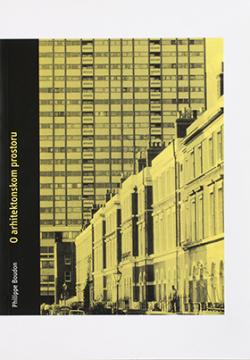
O arhitektonskom prostoru: eseji o epistemologiji arhitekture

O arhitektonskom prostoru: eseji o epistemologiji arhitekture

Philippe Boudon

Philippe Boudon, architect and theoretician of architecture, is the originator of the scientific discipline called architecturology, which aims to understand architecture from the point of view of scale and proportion.

The question he asked at the very beginning of his research, which began in the early 70s, is: "How does an architect determine the scale of space?" The answer that follows is the result of several decades of research, parts of which are collected in the repeated edition of the book On architectural space. An essay on the epistemology of architecture that we bring in a Croatian translation.

As a visiting professor, Philippe Boudon taught at the University of Ghent, Harvard University and the Architectural Association in London. He was awarded the Grand Prix de la Critique Architecturale in 1986 for his research and published works. He is one of the founders of the magazine Architecture-Mouvement-Continuité (AMC, published since 1967). He published numerous articles on the topic of architecturology, epistemology of architecture, concepts of architectural space. His most famous work is Pessac de Le Corbusier (Dunod, Paris, [1969] 1984).

Translation
Milena Bekić Milinović
Editor
Sandra Križić-Roban
Graphics design
Igor Kuduz
Dimensions
23.5 x 18.5 cm
Pages
159
Publisher
Institut za povijest umjetnosti Sveučilišta u Zagrebu, Zagreb, 2006.
 
Latin alphabet. Paperback.
Language: Croatian.
ISBN
978-9-53610-660-8

One copy is available

Condition:New
 

Are you interested in another book? You can search the offer using our search engine or browse books by category.

You may also be interested in these titles

Slaveni u renesansi

Slaveni u renesansi

Slobodan Prosperov Novak

An exceptional, extensive interdisciplinary monograph by Slobodan Prosperov Novak about the Slavs and their efforts in the 15th and 16th centuries to approach their Western European contemporaries and role models under the influence of the Italian Renaiss

Matica hrvatska, 2009.
Croatian. Latin alphabet. Hardcover with dust jacket.
23.90
Zagreb 1910.–1913.

Zagreb 1910.–1913.

Vjekoslav Klaić

"Zagreb 1910–1913" by Vjekoslav Klaić is a monograph on the development of Zagreb on the eve of World War I – an urban, cultural, economic and political overview of the city at the turn of the 19th and 20th centuries.

Knjižarnica Lavoslava Hartmana, 1918.
Croatian. Latin alphabet. Paperback.
14.26
Stari Zagreb

Stari Zagreb

Gjuro Szabo

A classic work of Croatian historiography, published in 1941, which provides a fascinating overview of the historical development of Zagreb, from its earliest mentions to Szabin's time, and is an indispensable source for anyone who wants to better underst

Spektar, 1971.
Croatian. Latin alphabet. Hardcover.
11.32
Petrografija

Petrografija

Luka Marić

For students of architecture, civil engineering, fine and applied arts.

Školska knjiga, 1951.
Croatian. Latin alphabet. Hardcover.
7.96
Palača cara Dioklecijana u Splitu

Palača cara Dioklecijana u Splitu

Frane Bulić, Ljubo Karaman

The work of Bulić and Karaman depicts the creation and development of Diocletian's Palace in Split, its historical transformation and significance as a monument of Roman architecture and later an urban center.

Matica hrvatska, 1927.
Croatian. Latin alphabet. Hardcover.
12.46
Velike arhitekture svijeta

Velike arhitekture svijeta

John Julius Norwich

The book includes: Non-European Architecture, Old World, Renaissance, Architecture of the New Age, Geographical Lexicon and Interpreter of Professional Terms.

Marjan tisak, 2005.
Croatian. Latin alphabet. Paperback.
5.62