Putovanje jednog prirodoslovca oko svijeta 1-2
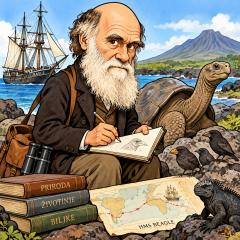
A Naturalist's Voyage Around the World (1839) is a scientific journal from the voyage aboard the HMS Beagle (1831–1836). A classic of travel and natural history literature that laid the foundation for Darwin's theory of evolution.
A Naturalist's Voyage Around the World is Darwin's first and most widely read book. It was published in 1839 and was later revised several times.
The book was written as a scientific journal of a five-year voyage by the young Darwin (then aged 22–27) as a naturalist aboard the HMS Beagle under the command of Robert Fitzroy. The voyage covered South America, the Galápagos Islands, Australia, New Zealand, the South Atlantic, and many other locations.
In contrast to the dry scientific report, Darwin writes in a lively, literary style. He describes geological phenomena (especially volcanoes and the rise of the Andes), fossils, plants, animals, and indigenous peoples. The sections on the Galápagos Islands are particularly famous, where he noticed small but significant differences between species (tortoises, finches), which later led him to the theory of evolution by natural selection.
The work is extremely important because it shows Darwin's development as a scientist: from a young naturalist influenced by Lyell's geological uniformitarianism to a thinker who laid the foundations of a revolutionary biological theory. At the same time, it is an extraordinary travelogue full of adventure, description of nature and sharp observations about society, slavery and colonialism.
The book consists of two volumes.
Jedan višetomni primjerak je u ponudi.