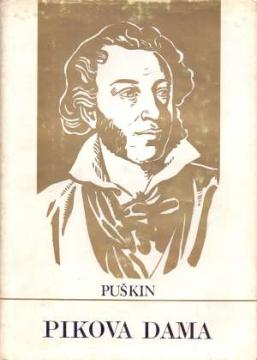
Pikova dama

Pikova dama

Aleksandar Sergejevič Puškin

In this story, Pushkin deals with the themes of love, longing, morality and human weakness. The main character, Herman, is obsessed with a secret card that promises him riches.

Alexander Sergeyevich Pushkin, known as the "father of Russian literature", left a deep and lasting impact on Russian literature. Pushkin was a pioneer in the development of Russian prose. His novels, such as "The Captain's Daughter" and "The Queen of Spades", laid the foundations for modern Russian prose. In short, Pushkin was a key figure in the development of Russian literature, and his legacy lives on today through the works of many writers.

Translation
Božidar Kovačević
Editor
Izet Sarajlić
Graphics design
Mario Mikulić
Dimensions
21 x 17 cm
Pages
244
Publisher
Veselin Masleša, Sarajevo, 1969.
 
Latin alphabet. Hardcover with dust jacket.
Language: Croatian.

No copies available

The last copy was sold recently.
 

Are you interested in another book? You can search the offer using our search engine or browse books by category.

You may also be interested in these titles

Kapetanova kći

Kapetanova kći

Aleksandar Sergejevič Puškin
Branko Đonović, 1963.
Serbian. Latin alphabet. Hardcover.
4.62
Bajke

Bajke

Aleksandar Sergejevič Puškin
Školska knjiga, 1982.
Croatian. Latin alphabet. Paperback.
2.22
Istorija Pugačova

Istorija Pugačova

Aleksandar Sergejevič Puškin
Rad.
Croatian. Latin alphabet. Hardcover with dust jacket.
6.48
Kornel večernji

Kornel večernji

Deszo Kosztolanyi

Deze Kostolanyi is an exceptional Hungarian artist, originally from Subotica, who has achieved success in many literary genres, from poetry to essays to theater plays.

Dereta, 1999.
Serbian. Cyrillic alphabet. Paperback.
8.28
Ludi svet od Džonatana

Ludi svet od Džonatana

Radomir Smiljanić
NIRO Književne novine, 1981.
Serbian. Latin alphabet. Paperback.
2.99
Homo faber

Homo faber

Max Frisch

Homo Faber by Max Friš is one of the most important and most read books of the 20th century: engineer Valter Faber believes in his rational view of the world, which is permanently shattered by a 'love story'.

Bratstvo-Jedinstvo, 1962.
Serbian. Latin alphabet. Hardcover.
3.16