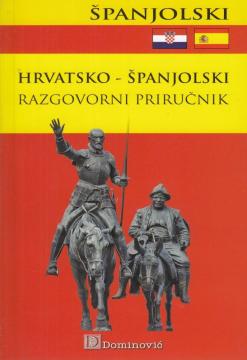
Hrvatsko-španjolski razgovorni priručnik

Hrvatsko-španjolski razgovorni priručnik

Nataša Dragojević

The Spanish language is a Romance language which, with the arrival of the Romans, developed in the 2nd century from a dialect of the Latin language, i.e. Vulgar Latin, when the older Iberian languages ​​were suppressed.

The basis of the Spanish language is the Castilian dialect named after the Spanish province of Castillo. After the discovery of America, it spread to the South American continent, where it has continued to this day in most countries. According to the number of speakers, Spanish is the most widely spoken language in the world, after Chinese. It is spoken by about 400 million people. It is the mother tongue of the inhabitants of twenty-one countries (Spain, the Canary Islands, all Central and South American countries, except Brazil). It is one of the six official languages ​​of the United Nations and the language of the European Union, and on the Internet it is, after English, the most commonly used language. There are many benefits to learning Spanish, and this guide will help you master the basics.

Translation
Nataša Dragojević
Editor
Mladen Jelić
Graphics design
Antonija Sarjanović
Dimensions
17 x 10.5 cm
Pages
212
Publisher
Dominović, Zagreb, 2013.
 
Latin alphabet. Paperback.
Language: Croatian.
ISBN
978-9-53795-403-1

No copies available

The last copy was sold recently.
 

Are you interested in another book? You can search the offer using our search engine or browse books by category.

You may also be interested in these titles

Mali leksikon hrvatske književnosti

Mali leksikon hrvatske književnosti

Vlaho Bogišić

The first contemporary handbook that summarizes basic information about Croatian literature in a lexicographical manner. It contains around 10,000 encyclopedic lines, covering eighty essential writers, from humanists and Petrarchists to modern poets and s

Naprijed, 1998.
Croatian. Latin alphabet. Hardcover.
11.34
Gramatika hrvatskoga ili srpskoga književnog jezika

Gramatika hrvatskoga ili srpskoga književnog jezika

Toma Maretić

The Grammar of the Croatian or Serbian Literary Language (first ed. 1899, third 1963, Matica hrvatska) is a classic normative grammar of the Štokavian (Vukonian) type: sounds, forms, word formation, syntax.

Matica hrvatska, 1963.
Croatian. Latin alphabet. Hardcover with dust jacket.
9.32
Riznica znanja za mlade: životinje

Riznica znanja za mlade: životinje

The book "Treasure trove of knowledge for young people - Animals" (1981) is an educational book intended for children and young people, which presents the animal world in a simple and interesting way.

Jugoslavija, 1981.
Croatian. Latin alphabet. Hardcover.
6.00
Dječja naučna enciklopedija

Dječja naučna enciklopedija

Edward Brace

The encyclopedia covers topics such as nature, the human body, space, physics, chemistry, technology, and the animal world.

Stvarnost, 1973.
Croatian. Latin alphabet. Hardcover.
8.20
Nerezînski beseduâr: rječnik govora Nerezina na otoku Lošinju

Nerezînski beseduâr: rječnik govora Nerezina na otoku Lošinju

Onorato Bonić, Nataša Šprljan, Flavia Zorović

The work Nerezinski beseduâr is a dictionary of the speech of Nerezine on the island of Lošinj, which has almost 12,600 lexicographical entries, and is accompanied by contributions from local phraseology, paremiology and toponymy.

24 sata, 2023.
Croatian. Latin alphabet. Hardcover.
29.9026.91
Dječja enciklopedija znanja – Što?

Dječja enciklopedija znanja – Što?

The book is written in the form of questions and answers. The questions are simple, and there are always two answers: the first is short and intended for the youngest curious, while the second is more extensive and detailed, with color illustrations.

Mladinska knjiga, 1989.
Croatian. Latin alphabet. Hardcover.
4.26 - 4.98