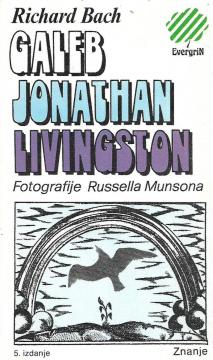
Galeb Jonathan Livingston

Galeb Jonathan Livingston

Richard Bach

The allegorical story of Jonathan the seagull has been one of the best-selling classics of spiritual-philosophical literature for decades, and millions of people consider it to have changed their lives. With Galeb Jontahan Livingston, we will fly to (un)k

The novel is written in short and clear sentences understandable by most ages. Along with the abundant interweaving of various storytelling techniques, we meet monologue, dialogue, description used to evoke various types of flying, and storytelling that evokes the life and behavior of seagulls. Elements of today's life can be found in many sentences.

Seagull Jonathan Livingston stands out from the flock because of his great desire to learn to fly as well as possible. Although he tried to fit in with the other seagulls, due to new flight experiments the flock ostracized him and he practiced in solitude. He soon encounters like-minded people and reaches incredible flying speeds that enable him to "jump" through space and time. He is also taught by the brave seagull Zhang. Jonathan had the need to return to his flock on Earth and in the end he himself becomes a teacher to the seagulls who, like him once, dared to fly freely and were ostracized. There were more and more of them. In the end, Johnatan moves on because he has done his job - he taught the other seagulls that there are no limits in the race for knowledge.

Original title
Jonathan Livingston Seagull
Translation
Diana Pavičić-Haniš
Editor
Zlatko Crnković
Illustrations
Russell Munson
Graphics design
Alfred Pal
Dimensions
20 x 12 cm
Pages
105
Publisher
Znanje, Zagreb, 1981.
 
Latin alphabet. Paperback.
Language: Croatian.

No copies available

The last copy was sold recently.
 

Are you interested in another book? You can search the offer using our search engine or browse books by category.

You may also be interested in these titles

Ni penija više, ni penija manje

Ni penija više, ni penija manje

Jeffrey Archer

Four men - a professor, a doctor, a gallery owner and an aristocrat - are swindled out of a million pounds by stockbroker Harvey Metcalfe. They team up for revenge, aiming to recover exactly what they lost through a series of ingeniously devised scams.

Otokar Keršovani, 1989.
Croatian. Latin alphabet. Paperback.
3.26
Skriveni cvet

Skriveni cvet

Pearl S. Buck

Japanese student Josui Sakai and American lieutenant Allen Kennedy fall in love in post-war Kyoto. They marry in a Buddhist temple, but racism and family obstacles in America lead to tragedy.

Svjetlost, 1965.
Serbian. Latin alphabet. Paperback.
2.34
Topaz

Topaz

Leon Uris

Topaz is a Cold War suspense novel by Leon Uris, published in 1967 by McGraw-Hill. The novel spent one week atop The New York Times Best Seller List, and was Uris's first New York Times number-one bestseller since Exodus in 1959.

Otokar Keršovani, 1970.
Croatian. Latin alphabet. Hardcover with dust jacket.
8.68
Pod prismotrom

Pod prismotrom

Mary Higgins-Clark

Journalist Sharon and young boy Neil, whose father is widowed after the brutal murder of his wife, are kidnapped by the real killer while an innocent man awaits execution. The psychopath holds them captive beneath Grand Central Station as time runs out to

24 sata, 1989.
Serbian. Latin alphabet. Paperback.
3.34
Žena koja je slikala kanom

Žena koja je slikala kanom

Alka Joshi

"The Woman Who Painted with Henna" is the debut novel of Indian-American author Alka Joshi, the first part of the Jaipur trilogy. The novel has been praised for its authentic portrayal of Rajasthani culture and the universal theme of female emancipation.

Mozaik knjiga, 2021.
Croatian. Latin alphabet. Paperback.
13.22
Odsustvo do buđenja

Odsustvo do buđenja

Leon Uris

Battle Cry (1953) is Leon Uris's debut novel based on his experience in World War II as a member of the 6th Marine Regiment.

Otokar Keršovani, 1970.
Croatian. Latin alphabet. Hardcover with dust jacket.
8.24