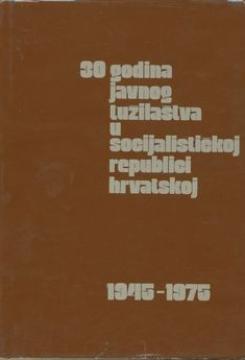
30 godina javnog tužilaštva u Socijalističkoj Republici Hrvatskoj (1945.-1975)

30 godina javnog tužilaštva u Socijalističkoj Republici Hrvatskoj (1945.-1975)

Franjo Hirjan, Branko Novaković, Ljubo Prvan, Mladen Singer, Bogumil Zuccon

Changes in this period were aimed at strengthening the role of the prosecution in the legal system and adapting to new social and political circumstances.

During the period from 1945 to 1975, the Public Prosecutor's Office of the Socialist Republic of Croatia went through several key changes:

  1. Establishment and organization: After the Second World War, in 1945, the Public Prosecutor's Office was established as part of the new socialist legal system. His role was to protect social order and the interests of the state.
  2. Reforms of the legal system: During the 1950s and 1960s, numerous legal reforms were carried out that aimed to modernize and adapt the legal system to socialist principles. This included changes in the legislation and procedures of the prosecution.
  3. Political influence: In this period, the prosecution had a significant role in the political life of the country. It was involved in trials against political opponents and in suppressing dissident activities.
  4. Education and professionalization: Increased attention has been paid to the education and professionalization of staff in the prosecutor's office. Training and specialization programs for prosecutors have been introduced to improve their expertise.
  5. Changes in legislation: Adoption of new laws and regulations, as well as changes to existing ones, affected the work of the prosecution. This included adaptation to international standards and practices.

Editor
Željko Jovanović
Graphics design
Ivo Vrtarić
Dimensions
24 x 17 cm
Pages
150
Publisher
Javno tužilaštvo Hrvatske, Zagreb, 1977.
 
Latin alphabet. Hardcover with dust jacket.
Language: Croatian.

No copies available

The last copy was sold recently.


Are you interested in another book? You can search the offer using our search engine or browse books by category.

You may also be interested in these titles

Važnost nalaza ranosrednjovjekovnog koplja u Varaždinu

Važnost nalaza ranosrednjovjekovnog koplja u Varaždinu

Željko Tomičić
Jugoslavenska akademija znanosti i umjetnosti, 1968.
Croatian. Latin alphabet. Paperback.
4.98
Zagreb tisuću devetsto četrdeset prve

Zagreb tisuću devetsto četrdeset prve

Ivan Šibl

"Zagreb one thousand nine hundred and forty-first" is not only a historical overview of events, but at the same time it is also a book in which the author vividly and directly outlined dozens of portraits. A book that is at the same time a historiographic

Naprijed, 1967.
Croatian. Latin alphabet. Hardcover with dust jacket.
7.98
S tradicionalnih na nove puteve: Trgovina, obrt, industrija i bankarske ustanove grada Osijeka na prijelazu stoljeća od 1868. do 1918. godine

S tradicionalnih na nove puteve: Trgovina, obrt, industrija i bankarske ustanove grada Osijeka na prijelazu stoljeća od 1868. do 1918. godine

Zlata Živaković-Kerže

The book explores the economic development of Osijek after the Croatian-Hungarian Settlement until the end of World War I. Osijek, as an important center of Slavonia, experienced a significant economic boom thanks to its location on the Drava River and th

Hrvatski institut za povijest, 1999.
Croatian. Latin alphabet. Hardcover.
7.32
O kraljevstvu Dalmacije i Hrvatske

O kraljevstvu Dalmacije i Hrvatske

Ivan Lučić-Lucius

The life work of Ivan Lučić and the debut of Croatian historiography (first printed in 1666 in Amsterdam). The work appears for the first time in the form the author intended, with the author's corrections and additions as well as critical treatment of in

Biblioteka Latina & Graeca, 1986.
Croatian. Latin alphabet. Paperback.
18.24
U ime države: trilogija - Prodaja

U ime države: trilogija - Prodaja

Matej Šurc, Blaž Zgaga
Jesenski i Turk, 2013.
Croatian. Latin alphabet. Paperback.
9.99
Hrvatski narodni vladari od god. 620.–1102.

Hrvatski narodni vladari od god. 620.–1102.

Mate Sagher

A pioneering attempt at a systematic presentation of Croatian political history from the settlement of Croats to the conclusion of a personal union with Hungary. Segher chronologically traces the development of Croatian statehood, relying on the sources a

Dionička tiskara, 1903.
Croatian. Latin alphabet. Paperback.
14.76