Operacija Walküre

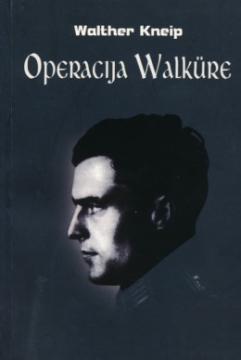
Operacija Walküre

Walther Kneip

The attempt to assassinate Adolf Hitler in 1944 in today's Germany is not exactly celebrated, regardless of the thousands executed, nor is the heroic undertaking of the one-armed war veteran Claus von Stauffenberg particularly glorified.

He was the only one of the anti-Hitler conspirators who found enough courage and inner strength to bring explosives into the Wolf's Den. For him, the solution was to kill the Führer, and only then start Operation Walküre, launch Wehrmacht units that would deal with the SS and occupy Berlin, Munich, Cologne and Vienna. The crazy idea of ​​an Anglo-American air landing on Berlin was also discussed, after which German soldiers would deal with Nazi units side by side with American and British paratroopers, and then the German army would conclude an armistice in the west and prolong the war against the Soviet Union. As tempting as this may sound, the overheated German war machine could not simply stop or spare the consequences of total defeat on all fronts, as well as the demand for unconditional capitulation sent from the meeting of the Big Three in Tehran. Colonel Count Stauffenberg, a descendant of the old Prussian military nobility, appeared not as the conscience of the nation, but only as the conscience of a small group of like-minded people, so most of their German contemporaries considered them traitors. Loyalty to the Führer was equated with loyalty to Germany - whoever was against Hitler was also against Germany. Of course, after the war, it will be argued that there were many who thought like Stauffenberg, but that they did not have the opportunity to express it. However, the Führer did not fight his war alone, and only one German tried to stop him.

Original title
Unternehmen ''Walküre''
Translation
Aleksandar Vojinović
Editor
Krešimir Maligec
Dimensions
20 x 14 cm
Pages
221
Publisher
Zagrebačka naklada, Zagreb, 2008.
 
Latin alphabet. Paperback.
Language: Croatian.
ISBN
385-0-10000-300-8

One copy is available

Condition:Used, excellent condition
 

Are you interested in another book? You can search the offer using our search engine or browse books by category.

You may also be interested in these titles

Bitka za Moskvu

Bitka za Moskvu

Branko Kitanović

The Battle of Moscow is a historical account of the German Operation "Barbarossa", the Soviet defense and counteroffensive in 1941. The author, with the testimonies of the top Soviet military leaders, shows how the first German defeat in the war unfolded.

Alfa, 1975.
Croatian. Latin alphabet. Hardcover with dust jacket.
7.96
Radni logor Valpovo 1945.-1946.: dokumenti

Radni logor Valpovo 1945.-1946.: dokumenti

Vladimir Geiger

The Valpovo labor camp (1945–1946) was the largest camp for Volksdeutschers in Croatia after World War II. About 4,000 Germans and Austrians were interned; at least 1,074 died, mostly from hunger, disease, and exhausting labor.

Njemačka zajednica podunavskih Švaba u Hrvatskoj, 1999.
Croatian. Latin alphabet. Hardcover.
27.34
Doživljaji i putovanja do slobode

Doživljaji i putovanja do slobode

Vladimir Novak

The autobiographical work of Croatian communist activist Vladimir Novak, a survivor of the Ustasha camps, follows his memories of resistance to fascism during World War II.

August Cesarec, 1979.
Croatian. Latin alphabet. Hardcover with dust jacket.
8.26
Pakao Pacifika 1-2

Pakao Pacifika 1-2

Boris Prikril

A book that has achieved extraordinary success. The reader cannot put it down until he has read it to the end. As if in a film, vividly and dynamically, the most dramatic events of World War II unfold before the reader's eyes.

Znanje, 1985.
Croatian. Latin alphabet. Hardcover with dust jacket.
The book consists of two volumes
4.98
Nevidljivi neprijatelj na Atlantiku 1-2

Nevidljivi neprijatelj na Atlantiku 1-2

Boris Prikril

The book provides a detailed account of naval conflicts in the Atlantic Ocean during World War II, with particular emphasis on the Battle of the Atlantic Convoy and the activities of German submarines – the so-called "invisible enemy".

Znanje, 1985.
Croatian. Latin alphabet. Hardcover with dust jacket.
The book consists of two volumes
6.985.24
Hrvatska borba za opstojnost 1918.-1998.

Hrvatska borba za opstojnost 1918.-1998.

Milivoj Kujundžić, Zdravko Dizdar

The book contains an account of the history of Croatia from 1918 to 1998 in four historical periods (1918-1941; 1941-1945, 1945-1990 and 1990-1998).

Hrvatski državni sabor, 2000.
Croatian. Latin alphabet. Hardcover.
6.42