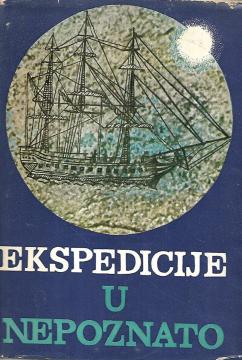
Ekspedicije u nepoznato: historija velikih geografskih otkrića na našoj planeti
Erich Rackwitz
The work was originally published in 1959 and was awarded the first prize for the promotion of literature for children and young people in 1960 and has been translated into several languages. As a follow-up, Rackwitz wrote "Sunken Worlds - Far S
Written by a renowned scientist and molecular medicine expert, this is a practical, science-based guide to cancer prevention. Intended for a general audience, the book explains the causes of cancer, risk factors, and strategies for reducing risk.
Globus, 1996.
Croatian. Latin alphabet. Hardcover with dust jacket.
At the Sources of Mathematics is a popular science work by Croatian mathematician, Japanologist, and academician Vladimir Devidé (1925–2010), published in 1979 in Osijek.
Revija, 1979.
Croatian. Latin alphabet. Paperback.
11.32 €
Journalism and media • Controversies and articles • Popular Science
In his book "Conspiracy Theories of the 21st Century," Velimir Grgić takes readers on an exciting journey through the labyrinth of contemporary disinformation. With a focus on the digital age, Grgić dissects the phenomenon of conspiracy theories, revealin
24 sata, 2021.
Croatian. Latin alphabet. Paperback.
8.36 €
Croatian history • Biography • Popular Science • Travel Books
The book by Zagreb travel writer and professor Juraj Bubalo is a kind of encyclopedia of Croatian travelers and explorers. Unique in Croatian non-fiction, it popularizes the culture of exploration and reminds us that Croats have been part of global discov
Meridijani, 2024.
Croatian. Latin alphabet. Hardcover.
28.32 €
Biology • Genetics • Animals and Nature • Popular Science
A popular scholarly monograph, edited by J. Z. Young and Tom Margerison. The 214-page book, richly illustrated in color, shows human development through the prism of scientific discoveries.
Mladinska knjiga Založba, 1975.
Serbian. Latin alphabet. Hardcover with dust jacket.
What exactly is television? How does it function in a promised land that uses it to produce its own history, and at a rapid pace, in the absence of a tradition of the European or any other ancient type?