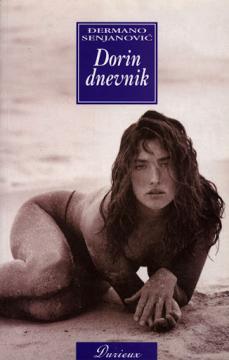
Dorin dnevnik

Dorin dnevnik

Đermano Senjanović

Dora's diary is prose of national significance, because Đerman Senjanović's texts skillfully depict our national and social everyday life, extremely spiritually distorted to the point of absurdity.

"Dora is a devoted wife and self-sacrificing mother of two children, a responsible clerk and a hard-working housewife to her family, and if this text had the intention of being instructive for any reason, then they would have realized that it might be about your and our first or any (city ) neighbors, into whose diary and head we have the opportunity to look thanks to the mediator Đerman Senjanović and the Durieux publishing house from Zagreb, which published the long-awaited Dora's Diary (1492-1996) at the beginning of April. In the middle are texts, namely, which Senjanović has been publishing regularly, from issue to issue, on the penultimate page of the Split weekly Feral Tribune for several years. And reading, which in that period represents certainly the best domestic prose, no matter how much such a statement irritates some, but often Croatian literary men who cannot imagine significant literature without the preceding and accompanying academic reality and arrogance ... Dora's diary is actually a surrealistically numbered inventory of controlled madness - her own, but clearly caused almost exclusively by external circumstances." (Free Dalmatia)

Editor
Nenad Popović
Dimensions
20 x 13 cm
Pages
335
Publisher
Durieux, Zagreb, 1997.
 
Latin alphabet. Paperback.
Language: Croatian.

No copies available

The last copy was sold recently.
 

Are you interested in another book? You can search the offer using our search engine or browse books by category.

You may also be interested in these titles

Od zore do mraka: izbor

Od zore do mraka: izbor

Fran Mažuranić

A selection from Mažuranić's fictionally branched cartoons, which were originally published, in an abridged edition, by Matica Hrvatska in 1927.

Minerva nakladna knjižara, 1941.
Croatian. Latin alphabet. Paperback.
6.36 €
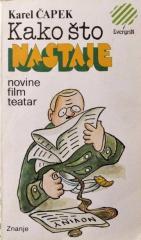
Kako što nastaje: novine, film, teatar

Kako što nastaje: novine, film, teatar

Čapek
Karel Čapek

In a witty and instructive essay, Čapek describes how a newspaper, a film, and a theater play are created. Through humor and irony, he shows the complexity of the process – from idea to realization – and the different perspectives of the participants, dem

Znanje, 1985.
Croatian. Latin alphabet. Paperback.
4.76 €
Naši ljudi i krajevi: Pejzaži, novele, crtice

Naši ljudi i krajevi: Pejzaži, novele, crtice

Antun Gustav Matoš, Fran Mažuranić

"Our People and Regions" is a collection of essays and travelogues by A. G. Matoš from 1910. The collection provides a deep insight into the Croatian regions and people of the early 20th century, reflecting Matoš's love for his homeland and his ability to

Spektar, 1974.
Croatian. Latin alphabet. Hardcover.
6.24 €
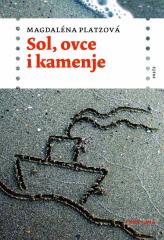
Sol, ovce i kamenje

Sol, ovce i kamenje

Magdaléna Platzová

Eine frische, unkonventionelle literarische Sicht auf Dalmatien. Vier Geschichten aus Dalmatien, erzählt im Stil der besten Werke tschechischer Literatur. Die Autorin erweckt die Düfte von Salz und Meer zum Leben und schreibt eine lebendige, farbenfrohe u

Fraktura, 2006.
Croatian. Latin alphabet. Paperback.
8.54 €
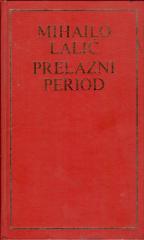
Prelazni period: Dnevnik posmatrača

Prelazni period: Dnevnik posmatrača

Mihailo Lalić

„Übergangszeit“ ist ein 1988 erschienener Roman des montenegrinischen und serbischen Schriftstellers Mihail Lalić. Die Arbeit trägt den Untertitel „Tagebuch eines Beobachters“, was auf einen introspektiven und reflektierenden Ansatz beim Geschichtenerzähl

Nolit, 1988.
Croatian. Latin alphabet. Hardcover.
7.52 €
Po-etika, knjiga druga

Po-etika, knjiga druga

Kiš
Danilo Kiš

Eine Sammlung von Interviews, die den ersten Aufsatzband von 1972 ergänzt. Als Dozent für Serbokroatisch an der Universität Bordeaux offenbart Kiš in Gesprächen den Kern seiner „Poetik“ – eine moralisch und ästhetisch aufgeladene Vision der Literatur als

Ideje, 1974.
Serbian. Latin alphabet. Paperback.
8.56 €