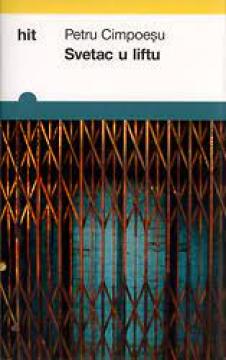
Svetac u liftu: Roman s anđelima i Moldavcima

Svetac u liftu: Roman s anđelima i Moldavcima

Petru Cimpoesu

The Saint in the Elevator by Petru Cimpoeşu is a satirical novel about the residents of a Romanian skyscraper who are disturbed by a rumor that a saint has appeared in the elevator. A seemingly ordinary event grows into a social phenomenon.

The Saint in the Elevator is a novel by Romanian writer Petru Cimpoeșu that depicts life in post-socialist Romania through humor, irony, and elements of the absurd. The plot is set in an apartment building in a provincial town, where a story begins to circulate among the residents that a saint has appeared in an elevator.

The alleged apparition provokes different reactions. Some residents accept the event as a miracle and a sign of divine presence, others remain skeptical, and still others try to use the situation for personal gain. Through their conversations, conflicts, and speculations, the author builds a mosaic of different destinies and mentalities.

The novel does not have a single main character. The center is on the numerous residents of the building: retirees, workers, small entrepreneurs, former party cadres, religious people, and opportunists. Each of them interprets the miracle according to their own interests, fears, and beliefs. As the rumor grows, the ordinary elevator becomes a place of pilgrimage, media attention, and social controversy.

Beneath the humorous surface lies a critique of a society that, after the fall of communism, is looking for new values and authorities. Cimpoeşu shows how religion, politics, the media and everyday interests easily intertwine and how people often believe rumors more than facts.

The Saint in the Elevator is at once a satire, a social novel and an allegory about the need for faith and meaning. Through a seemingly banal situation, the author depicts the confusion, hopes and contradictions of Romanian society at the transition to a new era.

Original title
Simion liftnicul
Translation
Mate Maras
Editor
Tomislav Zagoda
Dimensions
20 x 12 cm
Pages
347
Publisher
Znanje, Zagreb, 2009.
 
Latin alphabet. Hardcover with dust jacket.
Language: Croatian.

One copy is available

Condition:Used, excellent condition
 

Are you interested in another book? You can search the offer using our search engine or browse books by category.

You may also be interested in these titles

Kako biti stranac

Kako biti stranac

George Mikes

How to Be a Foreigner by George Mikes is a humorous book in which the author, as an immigrant from Hungary, humorously describes British customs, mentality, and everyday life from the perspective of a foreigner.

Znanje, 1980.
Croatian. Latin alphabet. Hardcover with dust jacket.
5.42
Asmodejev šal

Asmodejev šal

Ivan Aralica

Asmodeus' Scarf by Ivan Aralica is a novel that, through a symbolic and historical story, explores human nature, moral dilemmas, political conflicts, and the consequences of ideological divisions in Croatian society.

Znanje, 1988.
Croatian. Latin alphabet. Hardcover with dust jacket.
4.26
Krasopis

Krasopis

Pavao Pavličić

What happens when the writer himself is the protagonist of his novel and writes it in the first person? The answer to this question can be obtained by reading the novel "Krasopis".

Znanje, 1987.
Croatian. Latin alphabet. Hardcover with dust jacket.
4.36 - 4.42
Berenikina kosa

Berenikina kosa

Nedjeljko Fabrio

Berenik's Hair by Nedjeljka Fabrija is a historical novel that depicts complex social, political, and cultural changes in Croatia during the 20th century through the fates of individuals and families.

Znanje, 1990.
Croatian. Latin alphabet. Hardcover with dust jacket.
6.32
Kako to reći Liddy: jetka komedija

Kako to reći Liddy: jetka komedija

Anne Fine

Imagine four sisters who share everything from shopping marathons and family dinners to the most intimate secrets. Heather, Bridie, Stella and Liddy Palmer – unbreakable, loyal, impenetrable. Or so they think...

Znanje, 1998.
Croatian. Latin alphabet. Paperback.
3.46
Naivci

Naivci

Ivan Kušan

This is a humorous and satirical story about life in a small Dalmatian town, told through the perspective of a naive but insightful narrator.

Znanje, 1975.
Croatian. Latin alphabet. Hardcover with dust jacket.
3.64