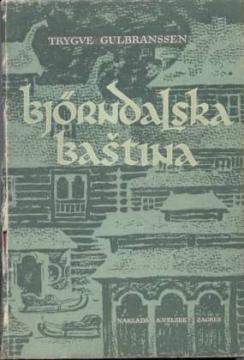
Björndalska baština: roman
Antique

Björndalska baština: roman

Trygve Gulbranssen

The novel follows the Björndal family, a close-knit clan living in the harsh Norwegian mountains. Through conflict, love, revenge and the fight for honor, it depicts their pride, tradition and the difficult journey towards reconciliation with their pasts.

The Björndal Legacy by Trygve Gulbranssen is the first part of a trilogy that depicts the life of the powerful but closed Björndal family, rooted in the wilderness of the Norwegian mountains. The novel is shaped as a family saga in which the fates of several generations are intertwined with the cruelty of nature, the old laws of honorable behavior and the pride that is passed down as an inheritance.

The center of the story is the patriarch Tore Björndal and his son Dag. Tore is a tough, unyielding man who enjoys an almost mythical reputation throughout the region. His strength inspires admiration, but also fear, and his past hides a whole series of conflicts and tragedies. Dag, the heir to the Björndal house, wants to forge his own path, but at the same time carries the burden of his father's deeds and the expectations of his environment. His path to maturity is marked by the struggle between his personal desire for tenderness and his inherited sense of duty.

The story also depicts Björndal's confrontation with the world around him — neighboring families, village dignitaries and social changes that threaten old customs. Tensions build through love affairs, misunderstandings, difficult decisions, and deadly conflicts where honor is more important than safety.

The novel highlights the contrast between the wild but honorable nature of the Björndal family and the hypocritical, sometimes cruel society of the valley. Through powerful psychological portraits and descriptions of the nature that shapes people, Gulbranssen creates a picture of a family that survives thanks to pride, loyalty, and an inexorable will to survive.

Original title
Der Blaser fra Dauningfjel / Ingen vei gar Utenom
Translation
Ivan Esih
Dimensions
20 x 14 cm
Pages
362
Publisher
Nakladni zavod Ante Velzek, Zagreb, 1944.
 
Latin alphabet. Hardcover.
Language: Croatian.

One copy is available

Condition:Used, good condition (visible signs of use)
Damages or inconvenience notice:
  • Damaged back
 

Are you interested in another book? You can search the offer using our search engine or browse books by category.

You may also be interested in these titles

Provincijalac

Provincijalac

Momo Kapor

As much as Foliranti is a story about Kapor's student days in Belgrade in the late fifties, Provincial is a book that evokes memories of his childhood in Sarajevo, where the author spent the first years of his life.

Znanje, 1984.
Serbian. Latin alphabet. Paperback.
5.32
Adolfove uši (Berlinski dnevnik)

Adolfove uši (Berlinski dnevnik)

Marko Pogačar

This is a manuscript first of all about yourself, about your own connection with the city, but also about the present and past of Berlin, and that then means about the death that is written into the history of a city that, more than others, grew together

Buybook, 2022.
Croatian. Latin alphabet. Hardcover.
8.16
Dijalektika prijelaznog perioda

Dijalektika prijelaznog perioda

Viktor Pelevin

The book represents the author's anthology - the largest part is the novel Čisla (Čisla), followed by the short story Macedonian Criticism of French Thought and several short stories (Odin vog, Akiko, Fokus-grupa, Gost na prazniku bon).

Disput, 2006.
Croatian. Latin alphabet. Paperback.
9.68
Melanholija 1-2

Melanholija 1-2

Jun Fose

Combining historical facts with fiction, the author draws us deep into the world of the artist's thin soul, whose vulnerability is caused by his tragic end, but who also possesses an incredible gift to see the divine beauty of the world where others would

Blum izdavaštvo, 1995.
Serbian. Latin alphabet. Paperback.
12.269.81
Historija odbačenih

Historija odbačenih

Jasmin Agić

The book is composed of 22 chapters, and in the first, introductory chapter, entitled The Ugly Face of Primitivism, Agić explains the reasons and mechanisms of social rejection.

Connectum, 2019.
Croatian. Latin alphabet. Paperback.
7.98
Večernji akt

Večernji akt

Pavao Pavličić

The story, centered on the brilliant forger Mihovil, criticizes the literature and art of our time. It also reflects on a society that is ready to adapt the coordinates of history to its own needs.

Znanje, 1981.
Croatian. Latin alphabet. Hardcover with dust jacket.
3.98