Ulica mačka ribara
Rare book
Antique

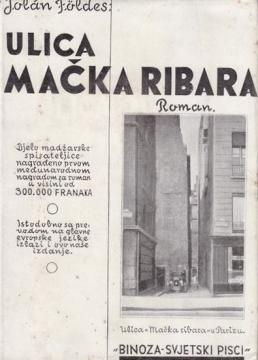
Ulica mačka ribara

Jolán Földes

The novel tells about the difficult life of a working-class family of Hungarian emigrants in Paris after the First World War. In 1936, he won the All Nations Prize for a novel by Pinter Publishing Ltd (London). Rarely offered with cover.

The action of the novel Fisherman's Cat Street takes place in the narrowest street in Paris (Rue du Chat-qui-Pêche) where Hungarian immigrants live. Although at first it seems like a typical story about a small community, the novel explores deep themes such as identity, social injustice and family dynamics.

The novel follows the life of Julie, who tries to break free from tradition and patriarchal frameworks, and at the same time has to face the emotional and social obstacles that arise in her family environment. Her path to freedom is not easy. Conflicts with her mother and her father's despair break through the emotional and psychological layers of the main character.

The novel Ulica Mačka Ribara is a poignant and deeply emotional depiction of family, social and psychological problems, as well as the internal conflict between tradition and modernism. Through the life of the main character Julie, the author explores the individual's striving for freedom and independence, while facing emotional and social pressures. Ulica Macka Ribara is not only a story about one family, but also a story about universal themes such as social isolation, love, tradition and the struggle for identity.

Original title
A halászó macska uccája
Translation
Paula Rendi
Dimensions
20 x 14 cm
Pages
236
Publisher
Binoza, Zagreb, 1937.
 
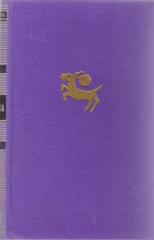
Latin alphabet. Hardcover with dust jacket.
Language: Croatian.

One copy is available

The cover is compact, but the inside has been upgraded and taped, because the back flap is missing.
Condition:Used, very good condition
Damages or inconvenience notice:
  • Damaged book cover
 

Are you interested in another book? You can search the offer using our search engine or browse books by category.

You may also be interested in these titles

Robijaši, kolonisti i kanaci

Robijaši, kolonisti i kanaci

Georges Ferre

Convicts, Colonists and Kanaks is a powerful story about life in a French penal colony, which explores justice, freedom and colonial exploitation through the fates of convicts, colonists and Kanaks, while criticizing the dehumanizing system.

Binoza, 1933.
Croatian. Latin alphabet. Hardcover with dust jacket.
7.525.64
Meštar Don Gesualdo

Meštar Don Gesualdo

Giovanni Verga

The novel is an important representative of verismo, Italian realism, and depicts the lives of people from the south of Italy, especially the conflicts between the poor peasantry and the decaying aristocracy.

Matica hrvatska, 1947.
Croatian. Latin alphabet. Hardcover with dust jacket.
8.42
Mrtvi kapitali

Mrtvi kapitali

Josip Kozarac

"Dead Capitals" (1890) is one of the most important works of Croatian realism and a strong critique of the social stagnation of the time. The novel shows the economic and social neglect of Slavonian villages under the Austro-Hungarian Empire through the c

Mladost, 1971.
Croatian. Latin alphabet. Hardcover.
3.56 - 6.22
Mati

Mati

Maksim Gorki

Maxim Gorky's novel "Mother" was published in 1906 and is one of the key works of Russian social realism. The work depicts the awakening of the working class in Russia through characters and events that emphasize social injustices and the need for revolut

Glas rada, 1950.
Croatian. Latin alphabet. Hardcover with dust jacket.
4.36
Mrtvi kapitali

Mrtvi kapitali

Josip Kozarac

"Dead Capitals" (1890) is one of the most important works of Croatian realism and a strong critique of the social stagnation of the time. The novel shows the economic and social neglect of Slavonian villages under the Austro-Hungarian Empire through the c

Mladost, 1961.
Croatian. Latin alphabet. Paperback with dust jacket.
3.82 - 3.98
Giga Barićeva 1-3

Giga Barićeva 1-3

Milan Begović

Giga Barićeva (1940) follows the life of Zagreb's bourgeois society during and after World War I. Begović's style, imbued with impressionism and wit, creates a panorama of society, while Giga personifies the struggle between freedom and expectations.

Zora, 1965.
Croatian. Latin alphabet. Hardcover with dust jacket.
The book consists of 3 volumes
26.16