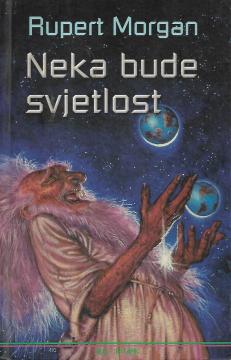
Neka bude svjetlost

Neka bude svjetlost

Rupert Morgan

The British Rupert Morgan claims in this novel that on the other side of the Sun there is a planet identical to Earth and that there live people just like us - only a little crazier. In fact, the people of the United States of Atlantis are totally unhinge

The novel follows the story of a futuristic world where corporations and technology dominate people's lives. The main character is a scientist working on a revolutionary project - the creation of an artificial energy source that could permanently solve the world's energy problems. This "light source" is supposed to bring prosperity to humanity, but soon it is discovered that its consequences are not what they seemed at the beginning.

As the project progresses, the scientist faces moral dilemmas, political pressures, and environmental disasters that result from excessive human greed and disregard for natural limits. Morgan humorously shows how the greed and short-sightedness of the corporate world can threaten the survival of the planet.

Morgan's novel calls for reflection on humanity's responsibility towards nature and technology. In a humorous tone, it sends a serious message about the need for sustainable development and a balance between progress and the preservation of the planet.

Original title
Let There Be Lite
Translation
Kristijan Vlašić
Editor
Neven Antičević
Illustrations
Igor Kordej
Dimensions
24 x 16 cm
Pages
359
Publisher
Algoritam, Zagreb, 2001.
 
Latin alphabet. Hardcover.
Language: Croatian.

No copies available

The last copy was sold recently.

 

Are you interested in another book? You can search the offer using our search engine or browse books by category.

You may also be interested in these titles

Sirius: Biblioteka znanstvene fantastike - broj 80

Sirius: Biblioteka znanstvene fantastike - broj 80

Mikhail Pukhov, Tom Godwin, Henry Slesar, Gerald Kersh, Damir Bajs, Arthur C. Clarke, Borivoje To...

Sirius was a Croatian science fiction magazine. The foundation was proposed by Damir Mikuličić in 1976. In Sirius, the works of domestic authors, as well as translations of foreign SF authors, were published. It was published from 1976 to 1989.

Vjesnik, 1983.
Croatian. Latin alphabet. Paperback.
3.24 - 3.46
Slavna budućnost naše zemlje

Slavna budućnost naše zemlje

Mirko Golubić

The book is a genre of popular science literature with elements of technological vision and futurism, characteristic of the era in which it was created – the time of the Cold War, the space race, and great expectations from science.

Znaci vremena, 1972.
Croatian. Latin alphabet. Paperback.
2.98
Puž golać na urvini

Puž golać na urvini

Arkadij Strugacki, Boris Strugacki
Narodna knjiga, 1988.
Serbian. Latin alphabet. Paperback with dust jacket.
6.58
Ploveće ostrvo

Ploveće ostrvo

Jules Verne

A science fiction novel by Jules Verne that depicts the adventures of musicians from a French quartet who accidentally find themselves on a huge, artificial island powered by motors - a floating continent called Standard Island.

Tehnička knjiga, 1957.
Serbian. Latin alphabet. Hardcover with dust jacket.
The book consists of two volumes
9.56
Otkrivanje vještica

Otkrivanje vještica

Deborah Harkness

The discovery of a mysterious alchemical manuscript in Oxford's Bodleian library will lead historian Diana Bishop, the only person in the world who can open it, to an unexpected search for its origins.

Fraktura, 2011.
Croatian. Latin alphabet. Hardcover with dust jacket.
8.98
Od krhkih krila do svemirskog broda

Od krhkih krila do svemirskog broda

Josip Modly

"From Fragile Wings to Spaceship" (1968) by Josip Modly is a popular science book that depicts the development of human flight, from the first attempts to construct aircraft to modern space exploration.

Školska knjiga, 1968.
Croatian. Latin alphabet. Paperback.
4.16