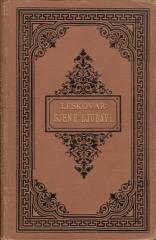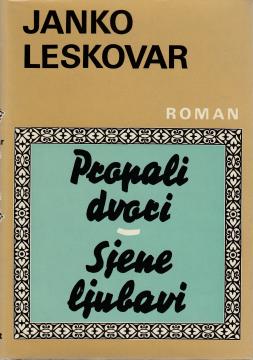
Propali dvori / Sjene ljubavi

Propali dvori / Sjene ljubavi

Janko Leskovar

"Propali dvori" is a novel by Janko Leskovar, published in 1896, which deals with deep psychological analyzes of the characters, emphasizing internal conflicts and feelings of disharmony with the outside world.

The action takes place in the surroundings of a ruined noble estate, which symbolizes decadence and the decay of former wealth. The main character, Fabijan Knezović, is a young man of humble origin, but highly educated and idealistic. Fabijan comes to the estate of the Kamiločević family, which is on the verge of financial ruin.

The family consists of the elderly Kamiločević, whose energy is spent, and his daughter Laura, a young but depressed woman, burdened by the burden of the family's past and social expectations. Fabijan falls in love with Laura, but that love is doomed in advance because of Laura's melancholy, which prevents her from finding happiness or a way out of her own psychological darkness.

Fabijan tries to help his family and restore the estate, believing in the power of work and will. However, faced with Laura's emotional coldness and his own growing doubts about the possibility of change, he eventually gives up on his attempts. Laura remains imprisoned in her suffering, and Fabijan leaves, deeply disappointed.

Dimensions
20 x 14 cm
Pages
263
Publisher
Mladost, Zagreb, 1978.
 
Latin alphabet. Hardcover with dust jacket.
Language: Croatian.

One copy is available

Condition:Unused
 

Are you interested in another book? You can search the offer using our search engine or browse books by category.

You may also be interested in these titles

I ne reče ni reči

I ne reče ni reči

Heinrich Böll

In Boll's novels, one of the central themes is the attempt to preserve basic moral values ​​in a time of terror, as well as in a period of material prosperity and corruption.

Svjetlost, 1965.
Serbian. Latin alphabet. Paperback.
3.22 - 3.98
Ulazeći u Varcar

Ulazeći u Varcar

Ivan Lovrenović

The hybrid book – a novel, poem and essay in one – is a dedication to his native Varcar, a small village in central Bosnia, where the author's roots intertwine with the history, myth and chaos of the 20th century.

Fraktura, 2016.
Croatian. Latin alphabet. Hardcover with dust jacket.
14.42
Proces

Proces

Franz Kafka

Kafka wrote The Process between 1914 and 1915, published posthumously in 1925. The novel is unfinished but with an added final chapter by Max Brod. Edition with a foreword by B. Živojinović and an afterword by Walter Killi.

BIGZ, 1990.
Serbian. Latin alphabet. Paperback.
4.26
Magična ljubavna kutijica

Magična ljubavna kutijica

Santa Montefiore

The Magic Love Box (2002) follows the life story of Federica Campione, which begins in Vina del Mar, Chile, in the summer of 1982. Montefiore creates an epic story of growth, where the magic is not only in the box, but in the courage to let go of the past

Mozaik knjiga, 2006.
Croatian. Latin alphabet. Hardcover.
7.34
Shannonov put

Shannonov put

Archibald Joseph Cronin

Cronin's moving story of redemption. Robert Shannon, a fanatical doctor-researcher, sacrifices love and life for science, but in the end loses everything – his girlfriend, recognition, health – only to realize through suffering: medicine without humanity

Otokar Keršovani, 1966.
Croatian. Latin alphabet. Hardcover with dust jacket.
6.24
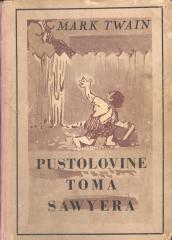
Pustolovine Toma Sawyera

Pustolovine Toma Sawyera

Mark Twain

The Adventures of Tom Sawyer is the first truly realistic children's novel, not only in American but also in world children's literature. Twain's most famous work and a favorite children's book in which the writer described his boyhood experiences.

Nakladni zavod Hrvatske, 1947.
Croatian. Latin alphabet. Hardcover.
16.32