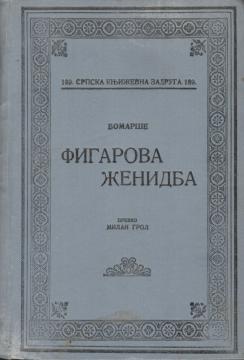
Figarova ženidba ili Ludi dan: Komedija u pet ćinova
Antique

Figarova ženidba ili Ludi dan: Komedija u pet ćinova

Pierre-Augustin Caron de Beaumarchais

The comedy "The Marriage of Figaro, or The Mad Day" (1784) is a sequel to The Barber of Seville. The Marriage of Figaro criticizes social injustices through love affairs and intrigue, celebrating Figaro and Susanna's ingenuity in the fight against aristoc

Set in Spain, the play follows Figaro, a servant of Count Almaviva, who plans to marry Susanna, the count's maid. The plot unfolds over the course of a "crazy day" filled with intrigue, misunderstandings, and social criticism.

Count Almaviva, tired of his marriage to Countess Rosina, tries to seduce Susanna, using his feudal right. Figaro and Susanna, with the help of the countess, devise plans to outwit the count. Other characters also participate in the plot: the adolescent Cherubin, in love with the countess, and Marcellina, who tries to force Figaro into marriage because of an old debt. Through disguises, hiding, and revealing, the comedy reaches its climax in a night scene in the garden, where the characters' true intentions are revealed.

Beaumarchais skillfully combines humor, satire, and criticism of the aristocracy, heralding the spirit of the French Revolution. The play mocks class differences, hypocrisy, and male dominance, celebrating the intelligence and ingenuity of the lower classes. Figaro's monologues, especially about injustice, carry a strong political message. The musical rhythm of the dialogue and the fast-paced action make the comedy dynamic.

Original title
Le Mariage de Figaro
Translation
Milan Grol
Dimensions
19 x 13 cm
Pages
183
Publisher
Srpska književna zadruga (SKZ), Beograd, 1925.
 
Cyrillic alphabet. Hardcover.
Language: Serbian.

One copy is available

Seal of the Government of the Free and Royal City of Osijek.
Condition:Used, excellent condition
 

Are you interested in another book? You can search the offer using our search engine or browse books by category.

You may also be interested in these titles

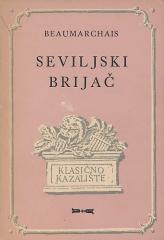
Seviljski brijač

Seviljski brijač

Pierre-Augustin Caron de Beaumarchais
Nakladni zavod Hrvatske, 1949.
Croatian. Latin alphabet. Paperback with dust jacket.
9.99
Turcaret

Turcaret

Alain-René Lesage
Nakladni zavod Hrvatske, 1948.
Croatian. Latin alphabet. Paperback.
3.06
Tvrdica - Rodoljupci

Tvrdica - Rodoljupci

Jovan Sterija Popović

Together, these two comedies show Steria as a master of satire, who exposes society's flaws through humor: in "Tvrdica" human greed, and in "Rodoljupci" political hypocrisy.

Školska knjiga, 1974.
Croatian. Latin alphabet. Paperback.
3.96 - 3.98
Why We Suck: A Feel Good Guide to Staying Fat, Loud, Lazy and Stupid

Why We Suck: A Feel Good Guide to Staying Fat, Loud, Lazy and Stupid

Denis Leary

A satirical, uncompromising and highly provocative book by Denis Leary, comedian and stand-up artist, written in the form of a long, cynical, swearing and aggressive monologue that reads like an extended stand-up performance on paper.

Penguin books, 2009.
English. Latin alphabet. Paperback.
6.365.09
Kako biti stranac

Kako biti stranac

George Mikes

"How to be a Foreigner" is a collection of humorous essays by the British writer of Hungarian origin George Mikes, who humorously describes the cultural differences and absurdities he encountered during his life in Great Britain.

Znanje, 1980.
Croatian. Latin alphabet. Hardcover with dust jacket.
5.42